Will the Union Budget 2022 Accommodate an Increase in Section 80D Deduction Limit?
Rounaq Neroy
Jan 25, 2022
Listen to Will the Union Budget 2022 Accommodate an Increase in Section 80D Deduction Limit?
00:00
00:00
As the Union Budget 2022 approaches, various sections of society have started presenting their wishlist to the finance ministry.
While a few people such as Mr. Subramanian Swamy, a renowned economist and BJP leader, have been asking for the complete abolition of income tax, the industry is hoping for a softer tax regime that could potentially spur demand.
Given the fragile state of recovery and potential worry of the widening of current account and fiscal deficit, the government is unlikely to take any radical measure in my view. However, I believe given the experience of the common man during the COVID-19 pandemic, the government must increase the deduction available under Section 80D of the Income Tax Act, 1961 for health insurance premiums paid.
As you might be aware, the health insurance premium you pay for yourself, your spouse, children and parents qualify for a deduction under Section 80D of the Income Tax Act. Note, the preventive health check-ups you do also entitle you to a tax benefit included in this deduction.
Table: Deductions Available to Taxpayers u/s 80D
| Individuals covered |
Exemption Limit in Rs (Self, family, and children) |
Exemption Limit in Rs (Parents) |
Total Exemption (in Rs) |
| Self and family |
25,000 |
0 |
25,000 |
| Self and family + parents below 60 years of age |
25,000 |
25,000 |
50,000 |
| Self and family + senior citizen parents |
25,000 |
50,000 |
75,000 |
| Senior citizen self and family + senior citizen parents |
50,000 |
50,000 |
1,00,000 |
Note: Deduction limit available is per financial year and includes expenses up to Rs 5,000 on preventive health check-ups
(PersonalFN Research)
Many of you probably have health insurance coverage under a group medical insurance policy your employer has provided. Yet in addition to that, you must buy a voluntary personal health insurance policy for yourself and also for your dependent family members.
Suppose you leave a job a few years down the line for better opportunities, the health insurance cover provided by the employer may cease to exist. Very few employers will continue to offer you medical insurance after you retire.
[Read: Why Corporate Health Insurance Isn't Enough for Your Family Health Needs?]
You see, the COVID-19 pandemic, the stress, and the lifestyle we lead have increased the uncertainty about our health. Besides, the cost of healthcare, as you may know, has gone up considerably (medical inflation is at around 15%-20%)--particularly after the second wave of the COVID-19 pandemic.
Until the COVID-19 pandemic struck us very hard, many had taken health insurance needs lightly. But the ongoing pandemic has been an eye-opener--not only for those who didn't have any cover, but also for those who had inadequate health insurance cover.
According to IRDA data, insurance companies in India settled 1.4 crore claims of health insurance amounting to Rs 43,355 crore in FY21. This means the average claim amount paid per claim was around Rs 30,900.
Now those living in densely populated metros and urban areas can imagine how paltry this amount would be for COVID-19 patients (and even non-COVID patients). In other words, a sizeable section of the insured population first paid expenses out of their pocket and then received reimbursement, thereby upsetting their household budgets in the interim. Around 54% of claims were settled through cashless mode, whereas 41% of the claims were settled through reimbursement only.
Many naive policyholders spent money in anticipation of getting a reimbursement, only to find that the insurance company rejecting a majority of the claim amount later pointing at the fine-print or some other exclusions. This leaves me to therefore believe that the out of pocket expenses of many policyholders, despite having health insurance, could have been anywhere between 30%-70% over the past 18-20 months.
During the COVID-19 pandemic, certain hospitals hiked their charges substantially due to a surge in hospitalisations and limited operational capacity. However, certain state governments later did intervene at the local level to regulate some of the charges. General insurance companies, as a result, were flooded with insurance claims.
Currently, because of the pandemic-led rise in claims, several general insurance companies have increased their health insurance premiums. The policyholders, particularly the ones in the higher age groups and with comorbidities, have felt the maximum pinch.
Post COVID-19 too, health insurance affordability is likely to become a more critical issue with insurance premiums expected to rise in the range of 5%-15%, depending on policy features.
NITI Aayog published a report last year titled, Health Insurance for India's Missing Middle highlighting the need for the middle-income earning group of around 40 crore Indians to have health insurance. The report suggests that the middle-income earners in India are neither poor enough to be offered subsidized government-run insurance schemes nor are they rich enough to be able to afford private insurance schemes. The statistics given in this report are slightly disturbing: the Universal Health Coverage (UHC) under Ayushman Bharat offers health insurance benefits to India's bottom 40% population--basically, those earning up to Rs 72,000 per annum.
The report further estimates that India's 70% population is now getting health insurance benefits under various schemes, including 9% covered under private voluntary health insurance schemes. NITI Aayog has also mildly rebuked present insurance products of having targeted only at the rich.
Now, while the government is keen on a public-private partnership to get maximum people covered under some health insurance scheme, it has so far resisted lowering the high GST rate (of 18%) applicable on health insurance premiums. In a developing country like India, where there's limited social security, charging 18% GST on insurance is like telling citizens that good health is a luxury and everyone shouldn't expect it.
If health insurance premiums keep increasing to unaffordable levels and there is high GST (of 18%), health insurance in India, which anyway is underpenetrated (with less than 4% of the population holding a retail cover), may continue to remain the 'missing middle' for a long time.
 (Image source: freepik.com; medical vector created by macrovector)
Therefore, in the forthcoming Union Budget 2022, the government, in my view, should consider lowering the GST on health insurance policy alongside offering more incentives and relief by increasing the Section 80D deduction limit. Given that around 70% of healthcare cost is paid for from personal savings by the individual, as per the government statistics; if the government pays heed to my aforementioned suggestion, it would induce many individuals to buy a health insurance policy and potentially help resolve the problem of 'missing middle'.
As an individual, when you are addressing your health insurance needs, evaluate these other key factors so that you have adequate Health Insurance cover:
✔ Your and dependent family member's current personal health.
✔ Your family's medical history.
✔ The number of dependent family members you intend to cover under the Health Insurance policy.
✔ The state and city you reside (to assess the healthcare facilities, the cost, and networks of hospitals that have tie-up with the health insurer)
✔ Whether there are exclusions from the Health Insurance policy (viz. medical expenses arising out of a pandemic, war, riots, terrorist attack).
✔ Is there a co-pay clause (a clause in health insurance plans that requires cost-sharing by the insured).
✔ Whether certain day-care procedures are covered.
✔ What is the coverage for pre and post-hospitalisation expenses; the number of days allowed
✔ Are there any sub-limits on the room rents.
✔ Are there limits on preventive health check-ups, the ICU charges, the cost of treatment, surgeries (including the major ones), etc.
✔ Whether you, as the insured, have any pre-existing diseases.
When you are covering your family members under a floater Health Insurance plan, make sure the sum insured for each member is respectable enough; be realistic and factor in the medical inflation.
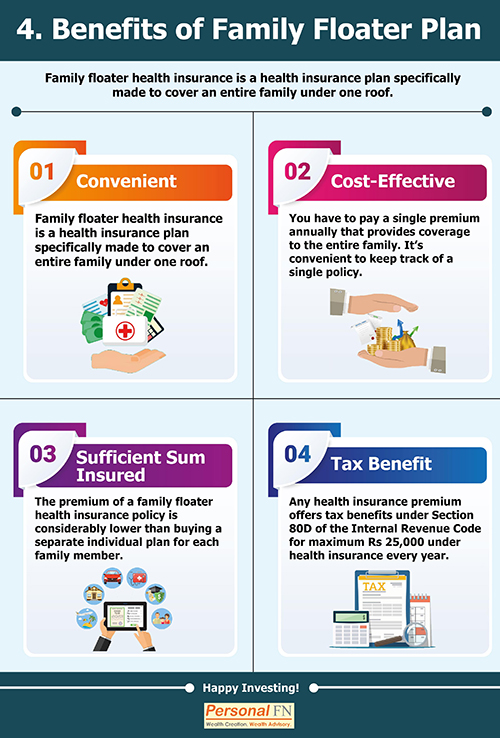
Over the years to come, medical inflation is expected to proliferate owing to the rise in fees of doctors, therapists, dieticians, pathological labs, and outlays towards administration, amongst a host of other things. Also, as age progresses, the chance of facing some or the other medical condition or disease would be high. Those above 50 years of age and already having chronic ailments or a history of lifestyle diseases, make sure the sum insured of your health insurance policy is adequate (even if means paying a higher premium).
Given that healthcare costs are increasing across most states and cities, ideally, if you can increase the sum insured by 8-10% every year, it would ensure the family's finances are not drained out to take care of a medical emergency. Consider following the general rule, "the higher your Health Insurance coverage, the better it is."
Keep in mind, having adequate health insurance is integral to the aspect of financial planning and will always serve to be in the interest of your and your family's financial wellbeing.
Warm Regards,
Rounaq Neroy
Editor, Daily Wealth Letter
PS: If you are looking for quality mutual fund schemes to add to your investment portfolio, I suggest you subscribe to PersonalFN's premium research service, FundSelect.
PersonalFN's FundSelect service provides insightful and practical guidance on which mutual fund schemes to Buy, Hold, and Sell. Currently, with the subscription to FundSelect, you could also get Free Bonus access to PersonalFN's Debt Fund recommendation service DebtSelect.
If you are serious about investing in a rewarding mutual fund scheme, subscribe now!
Join Now: PersonalFN is now on Telegram. Join FREE Today to get ‘Daily Wealth Letter’ and Exclusive Updates on Mutual Funds