Be it politics or investing, Indians are going beyond their conventional choices these days. An overwhelming referendum in favour of Aam Aadmi Party (AAP) in Delhi Legislative Assembly elections, shows political parties can no longer take voters for granted. Similarly, in investing, Indians are believed to be more inclined towards investing in physical assets rather than the financial assets. Gold is one of their favourites. However, you would be surprised to know that investors are selling gold and moving to financial assets of late.
Indian investors turning away from gold
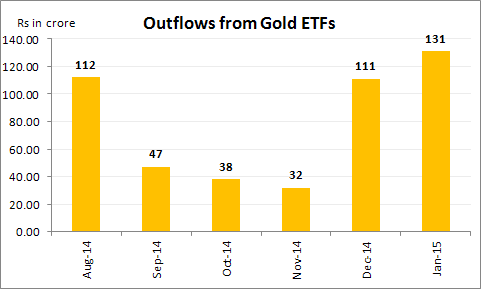
Data taken for the end of respective months, extracted as on February 17, 2015
(Source: AMFI, PersonalFN Research)
Gold prices in India are down nearly 10% over the last 1 year. While in the international market they have corrected around 7%. The Indian equity market (i.e. the S&P BSE Sensex) on the other hand, has delivered a return of little over 42% over last 1 year. The fall in gold and rise of in equities is not accidental; but reflect that amid the period of exuberance people are going risk-on, chasing an asset that is moving up in value and avoiding the one which is losing sheen. Equity mutual funds collectively saw an addition of 4.6 lakh new folios in January 2015, highest in any month from 2008. On the other hand, gold Exchange Traded Funds (ETFs) experienced outflows worth Rs 131 crore collectively.
Why gold is losing strength?
The primary factor that has depressed gold is strong U.S. Dollar. Now that world’s largest economy is showing signs of economic vigour amid accommodative monetary policy stance adopted by the U.S. Federal Reserve while the bond-buying programme has officially concluded; the green back has gained strength and macroeconomic variables such as job market data, consumer data, corporate earnings and housing data amongst host of others look promising. But along with that the probability of the U.S. Federal Reserve raising interest rates, somewhere in mid-2015 has also heightened. Such anticipation has made gold less favoured. The end of bond-buying programme of the U.S. Federal Reserve in October 2014, has already had a bearing on the precious yellow metal.
Having said this, the risk of deflation in the Eurozone, feeble economic growth rate and the situation of debt-overhang have been supportive for gold prices in global markets in January 2015. This is because; smart investors are taking refuge under gold for its trait of being a safe haven. Gold holdings in SPDR Gold Shares, the largest gold ETF in the world, went up nearly 9% in January 2015. But amid the period of risk-on, investors in India appear to be less concerned about global uncertainties and focused more on domestic factors, which is why they are avoiding gold.
Where’s gold headed?
Fragile conditions in Eurozone may continue to support gold prices but the major distinguishing factor would be the monetary policy stance of Federal Reserve in the U.S. Latest economic data suggests that, U.S. has been witnessing a broad based economic recovery as indicated by strong show of U.S. job market. In January, U.S. economy added 2,57,000 new non-farm jobs. Furthermore, data for November and December was revised substantially upward which suggests that, more than 10 lakh jobs have been added over last 3 months, which happened for the first time since 1997. Such developments have again given way to high probability that the Federal Reserve may increase interest rates in mid-2015. If that indeed happens, it would potentially push the U.S. dollar higher and may lead to gold lose sheen.
Speaking about in India, it remains to be seen what reform measures the Government takes to improve economic conditions. The forthcoming budget is the first-full budget of Modi-led-NDA and the electorates who voted the Government to power by a thumping majority have high expectations. While there’s a clamour for reducing import duty on the precious yellow metal, and a decrease can’t be ruled out; the magnitude of reduction needs to gauged carefully, considering the vulnerability of such a move on India’s Current Account Deficits, especially due to the strident demand from the jewellery industry.
What you should do?
PersonalFN is of the view that, investors should avoid speculative approach. Gold is an effective portfolio diversifier and hence you should allocate some portion of your investible surplus towards gold. At PersonalFN we recommend you should always hold 10%-15% of your portfolio in gold. But while you take exposure towards gold it is imperative that you invest in gold the smart way. Gold ETFs remain one of the best options, for the host of benefits it offers.
While you may continue to invest in equity as charted in your asset allocation plan, you should not undermine the importance of diversification since it may help you optimise returns for the risk taken. As gold usually shares negative co-relation with equities, it could effectively diversify your investment portfolio and also act as a hedge against inflation.
Add Comments