  | | August 16, 2013 | | | | | | | Weekly Facts | | | Close | Change | %Change | | BSE Sensex* | 18,598.18 | (191.2) | -1.02% | | Re/US$ | 61.44 | (0.1) | -0.23% | | Gold Rs/10g | 29,520.00 | 1,455.0 | 5.18% | | Crude ($/barrel) | 110.04 | 1.9 | 1.75% | | FD Rates (1-Yr) | 7.50% - 8.75% | Weekly change as on August 14, 2013
*BSE Sensex as on August 16, 2013 | |
Impact 
Like you, economic downturn is affecting even large corporate. Many of them have seen significant reduction in profits over the last financial year. This has affected their financial strength and so as their loan repayment capacity. Whenever, companies face a financial trouble, they are most likely to be downgraded. Such downgrades compound problems for companies; as they have to pay higher rate to attract money in future. In the present scenario where the short term borrowing rates are high and profitability of companies is under pressure, the list of companies facing downgrades has been increasing.
Debt funds investing in corporate debt are exposed to credit risk. When rating on the corporate debt is slashed; bond prices face a downward pressure as yields spike up. This is true especially in case of funds which invest in low quality debt to benefit from high yields.
PersonalFN is of the view that taking any call on the interest rate movement would be risky and investors shouldn't speculate. Moreover, investing in a debt fund which compromises on credit quality would be extremely risky. PersonalFN believes only those who have a high risk appetite may consider investing in long term debt funds at this juncture provided their time horizon is relatively long. Also, only upto 20% of your debt portfolio should be in long term debt funds. Debt funds concentrating on shorter end of the yield curve may expose investors to relatively low risk.
Recently, the government has allowed about 13 Public Sector Undertakings (PSUs) to raise Rs 48,000 crore by issuing tax free bonds. The bonds would be available in 10-year, 15-year or 20-year series. Since the bonds would be tax free and be issued by PSUs; they would track the yield on 10 year G-sec bonds and coupon rates may be 0.55%-0.80% lower than the yield on 10-year G-sec benchmark bond. PersonalFN believes, given the recent jump in G-sec yields, bonds may help you lock your money at higher rate for the longer term. Moreover, their 'tax-free' nature makes them even more attractive for investors falling in 30% tax bracket.
|
Impact
Concerned with weakness in the Indian rupee which has implication of widening Current Account Deficit (CAD); the Government once again increased the import duty on gold from 8% to 10%. It is noteworthy that this the third increase this calendar year, intended to curb demand for gold in India, the world's largest consumer of gold.
On an ascending trend
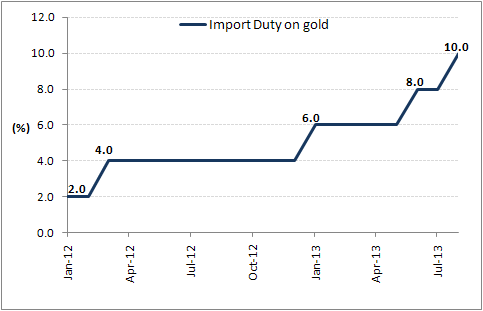
Data as on August 13, 2013
[Source: Ministry of Finance (Dept. of Revenue), PersonalFN Research)
Apart from targeting gold, the duty on platinum too has been increased to from 8% to 10%, and for silver to 10% from 6%. And such a move is expected to fetch Rs 4,830 crore to the exchequer.
Moreover, the additional duty on gold dore bars is increased from 6% to 8% and for silver dore bars from 3% to 7%. Dore bars are semi-pure alloy of gold and silver mined from ore and are imported in the country for further purification. Likewise the excise duty too is hiked; where for refined gold bars it is increased from 7% to 9%, while for silver manufacturing from ore and silver / gold dore bars from 4% to 8%.
How much are the gold imports thus far?
In the fiscal year 2012-13, India imported 845 tonnes of gold valued at over Rs 2.45 lakh crore. And this was the main reason for CAD to hit a record high of 4.5% (at U.S. $87.8 billion) of GDP.
In the current fiscal year thus far (i.e. for the period April 2013 to July 2013) gold imports have risen 87% to 383 tonnes (from 205 tonnes in the same period last year). In value terms, the imports went up from Rs 56,488 crore to Rs 95,092 crore - an increase of about 68%. But despite such data on gold imports and persistent weakness in rupee, the Government is vowing to restrict the current account deficit (CAD) to 3.7% of GDP, or U.S. $70 billion in the current fiscal.
To read more about this news and the view of PersonalFN over it, please click here.
---------------------- Introducing PersonalFN's Guide to Investing in Gold --------------------- Many of us buy gold with an emotional touch. And why not, the glitter which it presents and the feeling of content it gives are truly worth it.
PersonalFN has Just Released a Guide to Investment in Gold, which reveals the smart way of investing in gold.
Download Your FREE Copy Here!
|
Impact
Arsenal of RBI has been shrinking fast but the rupee is still in the free-fall mode. Despite taking a number of measures to curtail the depreciation in the rupee and make it stable; RBI has hardly achieved any success as yet. At the time of writing, rupee hit a fresh low of 62.00 against dollar. On the other hand, rising food prices have pushed inflation higher multiplying problems of the central bank. Rising inflation has made it harder for the central bank to support economic growth. Left with few options, RBI has continued to take even harder measures. This time, it has drastically reduced overseas investment limits of companies and individuals to curb outflow of dollars. Now, resident individuals can remit only $ 75,000 per financial year under Liberalised Remittance Scheme (LRS). Earlier, they were allowed to remit upto $ 200,000 every year. Moreover, investment limit of companies for Overseas Direct Investments (ODI) under automatic route for all fresh transactions has been substantially lowered to 100% of their networth from 400% earlier. Further, resident investors won't be allowed to use LRS window for acquiring immovable property outside India, directly or indirectly. RBI has clarified that genuine investment outside India won't be discouraged and would be considered in approval route.
PersonalFN believes that substantial reduction in the investment limit may help reduce outflow of dollars to some extent but unless Current Account Deficit (CAD) comes significantly lower and growth is revived; it may be difficult to attract durable foreign flows. PersonalFN is of the view that, investors should avoid taking any investment decision based on steps taken by RBI. Following asset allocation plan which considers your individual requirements would help.
|
Impact
Culture of 'credit' is spreading fast. People buy smartphones on EMIs and pay even hotel bills by credit cards these days. But not all of you are alike. Few of you must be applying for loans only occasionally and may be even pre-paying them. As you may be aware, all this gets counted in your credit score. But as of now, despite of having good credit scores you don't have much of a bargaining power with banks for availing cheaper loans. This may change very soon.
Here's why...
Today, barring few large banks, most of the other banks are using flat loan pricing model wherein good credit behaviour is not incentivised and bad one is not penalised. In India, credit scores have so far been used only to determine whether to accept or decline the credit application of the borrower. Lately, RBI addressed this issue and has specifically suggested banks to use credit scores even to price loans optimally. If banks start following this practice widely, bargaining with banks for cheaper loans might soon become reality for large number of borrowers.
How banks would assess your application?
Although your credit score might be the basis for banks to take a call on your request for cheaper loan; banks may consider some other factors as well. Factors such as income and occupation may be helpful to banks in determining the level of risk they might be exposed to. Furthermore, in case you hold a saving bank account with the same bank; it may try to analyse your saving account history. When combined all these aspects, banks may get fair idea about your financial behaviour.
To read more about this news and the view of PersonalFN over it, please click here.
|
- As many of you may be aware and may have even witnessed, that the Indian bond markets have been rather volatile after the Reserve Bank of India's (RBI's) move to contain the rupee.
Assessing the domestic and global macroeconomic backdrop, the RBI in its recent guidance to the 1st quarter review of monetary policy 2013-14 also mentioned that India is currently caught in a classic "impossible trinity" trilemma, where the risk emanates from:
- External sector concerns;
- Volatility in foreign exchange; and
- Current Account Deficit
And assessing the aforementioned scenario, the Government has drawn a strategy intended to boost dollar flows, but the success of the same remains to be seen.
But amid all this, weakness persists in the rupee and the Indian bond markets are yet volatile, with yields across maturities having risen (as much over 300 basis points since June-end). Taking advantage of such a scenario, mutual fund houses are launching Fixed Maturity Plans (FMPs) which have witnessed inflows as well.
PersonalFN is of the view that, the time of the launch of FMPs would enable investors to yield better risk-adjusted returns. But we think, given the aforementioned backdrop where rupee and CAD have taken the centre stage in the monetary policy which in turns pave the path for interest rates; in our view it would be wise to invest in FMPs offering maturity tenure of 3 months to 1 year and refrain investing in those offering maturity tenure of over 1 year.
|
Networth: The amount by which assets exceed liabilities. Net worth is a concept applicable to individuals and businesses as a key measure of how much an entity is worth. A consistent increase in net worth indicates good financial health; conversely, net worth may be depleted by annual operating losses or a substantial decrease in asset values relative to liabilities. In the business context, net worth is also known as book value or shareholders' equity.
(Source: Investopedia.com)
|
Quote : "Wall Street people learn nothing and forget everything." - Benjamin Graham
|
| |
| © Quantum Information Services Pvt. Ltd. All rights reserved.
Any act of copying, reproducing or distributing this newsletter whether wholly or in part, for any purpose without the permission of PersonalFN is strictly prohibited and shall be deemed to be copyright infringement.
Disclaimer: Quantum Information Services Pvt. Limited (PersonalFN) is not providing any investment advice through this service and, does not constitute or is not intended to constitute an offer to buy or sell, or a solicitation to an offer to buy or sell financial products, units or securities. All content and information is provided on an 'As Is' basis by PersonalFN. Information herein is believed to be reliable but PersonalFN does not warrant its completeness or accuracy and expressly disclaims all warranties and conditions of any kind, whether express or implied. PersonalFN and its subsidiaries / affiliates / sponsors or employees, personnel, directors will not be responsible for any direct / indirect loss or liability incurred by the user as a consequence of him or any other person on his behalf taking any investment decisions based on the contents and information provided herein. This is not a specific advisory service to meet the requirements of a specific client. Use of this information is at the user's own risk. The user must make his own investment decisions based on his specific investment objective and financial position and using such independent advisors as he believes necessary. All intellectual property rights emerging from this newsletter are and shall remain with PersonalFN. This is for your personal use and you shall not resell, copy, or redistribute this newsletter or any part of it, or use it for any commercial purpose. The performance data quoted represents past performance and does not guarantee future results. As a condition to accessing PersonalFN's content and website, you agree to our Terms and Conditions of Use, available here. |