  | | March 22, 2013 | | | | | | | Weekly Facts | | | Close | Change | %Change | | BSE Sensex* | 18,735.60 | (692.0) | -3.56% | | Re/US$ | 54.28 | 0.1
| 0.17% | | Gold Rs/10g | 29,680.00 | 375.0 | 1.28% | | Crude ($/barrel) | 108.39 | 0.3 | 0.23% | | FD Rates (1-Yr) | 7.25% - 9.00% | Weekly change as on March 21, 2013
*BSE Sensex as on March 22, 2013 | |
Impact 
Recently, a month back we wrote to you investors whether should your investment decision in mutual funds be based on their colour codes, after the Association of Mutual Funds in India (AMFI) put forth a proposal to the capital market regulator - the Securities and Exchange Board of India (SEBI), that colour codes be applied to mutual fund products (across equity and debt schemes).
And now SEBI has finally honoured this proposal and issued guidelines on "product labelling and colour coding" for mutual fund schemes, whereby it has been decided that product labels carrying details of the scheme be disclosed on the front page of initial offering application forms and they be also placed in common application forms and advertisements.
The labels would include details of the mutual fund scheme such as to create wealth or provide regular income in an indicative time horizon (short/ medium/ long term). Moreover, mutual funds would now be needed to state a brief about the investment objective in a single sentence followed by kind of product in which investor is investing i.e. whether equity or debt.
Speaking about colour coding for mutual fund schemes, it has been decided by the regulator to apply the following colour codes to signify the risk.
| Risk significance | Finalised by SEBI | Proposed by AMFI | | High | Brown | Red | | Medium | Yellow | Yellow | | Low | Blue | Green |
Also as per the guidelines, mutual funds would also have to include a disclaimer that "investors should consult their financial advisers if they are not clear about the suitability of the product".
We are of the view that, product labelling and colour coding may help mutual fund investors to recognise the nature of a mutual fund scheme and the trait which it carries. But this in itself may not be suffice in selecting winning mutual fund schemes for the portfolio, since that requires thorough risk profiling of oneself and evaluation of following aspects amongst others of a mutual fund scheme:
- Performance (which includes: returns, risk, risk-adjusted returns, etc.)
- Portfolio characteristics
- Fund management style
- Costs (in the form of expense ratio and exit loads)
Hence while the guidelines from SEBI are encouraging, it is noteworthy that for selecting winning mutual fund schemes a deeper study on the aforementioned facets is necessary.
|
Impact 
Many of you may have observed that in the last four months, gold prices in India have undergone a corrective phase with reform being put on the forefront and WPI inflation too depicting signs of moderation. But this corrective has encouraged many smart investors to gold.
Gold ETF AUM vs. Gold Prices in India
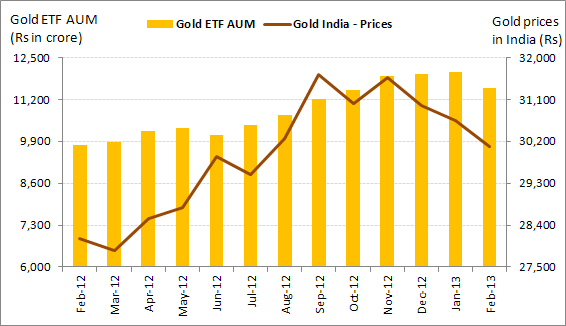
(Source: Office of the Economic Advisor, PersonalFN Research)
The chart above depicts a rising trend in Assets Under Management (AUM) of gold Exchange Traded Funds (ETFs) since July 2012 despite gold prices price on rise; and now that gold prices have languished (due to intermediate positives from global economy – especially the U.S.) many have bought gold further. It is noteworthy that during a seven month period from July 2012 to January 2013 the gold ETFs had witnessed net inflows, totalling to Rs 1,733 crore, thereby taking gold ETFs AUM to Rs 12,057 crore in January 2013. It was only last month (i.e. February 2013) that the rising trend in gold ETF seemed interrupted with a net outflow worth Rs 8 crore.
But is the uptrend indeed broken?
Well since the beginning of the financial year until February 2013, the overall trend still appears positive with Rs 1,501 crore net inflows seen in gold ETFs. Moreover we are of the view that if we do a holistic assessment of what is happening in the global economy, one would observe that uncertainty yet prevails in the global economy. In the U.S., although Q4 GDP growth has shown some signs of improvement, the macroeconomic prospects for the U.S. yet appear clouded by uncertainty surrounding the temporary appropriations and the debt ceiling. Speaking about the Euro zone, there too gloomy clouds of debt-overhang are evident although bailout packages are doled out and attempts to adopt austerity measures are made; and the entire Euro zone economy has been reporting shrinkage for three successive quarters. The central banks in the developed economies have adopted easy monetary policy to cater to growth risk, which we think would be supportive for the uptrend in gold, until the gloomy clouds disappear.
India would also remain susceptible to global economic headwinds along with its own domestic downbeat macroeconomic data. With slump in quarter-on-quarter economic growth, 'see-saw' movement in in industrial activity, twin deficit problems, risk of sovereign rating downgrade, FDI not kick-starting despite reform measures taken) and intermediate inflationary pressures perceived; many would take refuge under the precious yellow metal until this economic concerns do not recede. Every corrective, we think would encourage smart investors to buy gold and thus despite import duty on gold hike to 6.0%, demand would not deter.
So given the above backdrop where long-term economic problems still persist – especially in the developed economies, and now concerns over India's fiscal deficit, economic growth rate and sovereign rating downgrade concerns yet lingering around; we think the ascending move for gold is intact over the long-term, because smart investors would view gold as a monetary asset rather than mere commodity.
|
Impact 
As many of you may be aware, the Reserve Bank of India (RBI) in its 4th quarter mid-review of monetary policy 2012-13 (held on March 19, 2013) reduced the repo rate by 25 basis points (bps) in line with what the markets expected. With economic growth rate depicting a descending move and WPI inflation along with non-food manufacturing inflation providing some relief, the central bank attempted to address to growth risk to some extent.
In the fiscal year 2012-13 the RBI has reduced policy rates thrice, making a total reduction of 100 bps thus far. So given a fall in policy rates, many of you may be wondering whether gilt funds is best investment option in present times. To know whether it is indeed prudent to invest in gilt funds, please click here.
|
Impact
As tax payers many of us contribute in our country's economic growth by legitimately filing our Income-Tax return and paying tax thereon. But sometimes by the virtue of some provisions in the Income Tax Act and Tax Deducted at Source (TDS), our tax computation reveals that the Income-Tax Department owes us some money in the form of refunds due to excess tax paid or credits availed. We wait until the income tax authorities give us our legitimate amount of refund after having done an assessment thereto; but often we encounter delay in receiving our refund cheque or the amount be credited in our bank account (via the ECS mode). However now, one can soon expect Income-Tax refunds to be settled quickly and in a hassle-free manner, if the Finance Ministry has its way. To read more about this news and our view over it, please click here.
|
FREE Money Simplified Guide
Your Definitive Guide To Retirement Planning!
Download your FREE copy to know how you can indeed build the corpus for your golden days.
Click Here to get this most downloaded E-Guide, Now! | |
- In order to prevent misuse of lost or stolen cards, RBI has advised banks to consider issuing debit and credit cards with photographs of the cardholders. Banks have been advised by the RBI to also consider cards with PIN and signature laminated cards or any other advanced methods.
We are of the view that such an advice by RBI to banks, will help reduce the number credit card and debit card related misuse and frauds, and will therefore provide a safety net vide advanced method used to prevent misuse.
- Following a Cobrapost exposé which named three banks for money laundering, RBI has initiated a process of carrying out a comprehensive scrutiny, wherein it is also carrying out a thematic study in respect of banks that are active in selling gold coins / wealth management products, to examine whether there are systemic issues and to plug deficiencies and legal loopholes, if any.
We are of the view that, RBI has brought in the aforementioned activities under scrutiny assessing that such operations of banks being active and rampant misdoings taking place in them. Such a scrutiny by RBI we think will bring in vigilance and thus would help in bringing down instances of mis-selling and frauds occurring thereto.
|
Money laundering: The process of creating the appearance that large amounts of money obtained from serious crimes, such as drug trafficking or terrorist activity, originated from a legitimate source.
Source: Investopedia
|
Quote : "If you are shopping for common stocks, choose them the way you would buy groceries, not the way you would buy perfume." - Benjamin Graham
|
| |