To increase the investor-base and open up another financing avenue for real estate developers, the Securities and Exchange Board of India (SEBI) considered allowing Real Estate Investment Trusts (REITs) in India. The initial draft on regulation this effect was shaped in 2008, but subsequently the regulator withdrew it due to non-transparent valuation norms, dissimilar stamp duty structure across different states and the lack of uniformity in land and property pricing. Later in October 2013, SEBI revived the plan by issuing draft regulations for launching REITs in the country; and now recently the regulator has issued final guidelines for REITs.
So what are the guidelines broadly for REITs?
| Specifics |
Guidelines |
| Set up as |
Trust |
| Registration with |
SEBI |
| Investments by REITs |
Should be in commercial real estate, directly or via Special Purpose Vehicles (SPVs) |
| Controlling Interest |
For REITs: Not less than 50% of the equity share capital or interest For SPVs: It cannot hold less than 80% of its assets in properties and shall not invest in other SPVs |
| Minimum project investment |
Shall invest at least 2 projects with not more than 60% of the value in assets invested in one project |
| Other investment related guidelines |
- Not less than 80% of the value of the REIT assets shall be in completed and revenue generating properties
- Not more than 20% of REIT assets shall be invested in:
- developmental projects
- mortgaged backed securities
- listed / unlisted debt of companies / body corporates in the real estate sector
- equity shares of companies listed on the recognizes stock exchange in India which derive not less than 75% of the operating income from real estate activity
- government securities
- money market instruments or cash equivalents
|
| Distribution of earnings |
Shall not distribute less than 90% of net distributable cash flows, subject to applicable laws, to its investors, at least on a half-yearly basis. |
| Borrowing and deferred payments of REIT |
At a consolidated level borrowing / deferred payment shall not exceed 49% of the value of the REIT assets. In case borrowings / deferred payments exceed 25%, approval from unit holders and credit rating shall be required. |
| Valuation of REIT |
Through a valuer on a yearly basis and update the same on a half-yearly basis |
| Declaration of NAV |
Declare NAV within 15 days from the date of valuation / updation |
| Minimum value of assets that REITs must have to float an initial offer |
Rs 500 crore |
| Minimum size of the initial offer |
Rs 250 crore. Also, the units offered to the public in initial offer shall not be less than 25% of the number of units of the REIT on post-issue basis. |
| Minimum subscription size for units of REITs |
Rs 2 lakh |
| Trading lots for units |
Shall be in Rs 1 lakh |
| Listing |
On a recognised stock exchange |
| Disclosure norms |
As per terms of the listing agreement |
| Sponsors |
May have multiple but not more than 3, subject to each holding at least 5% of the units of the REIT. Such sponsors shall collectively hold not less than 25% of the units of the REIT for a period of not less than 3 years from the date of listing. After 3 years, the sponsors, collectively, shall hold minimum 15% of the units of REIT, throughout the life of the REIT. |
(Source: SEBI, PersonalFN Research)
Is India’s real estate industry excited?
Well, developers are of the view that not enough has been done to invigorate the industry and boost investments. They are finding the tax structure to be an irritant having many leakages.
You see, developers are uncomfortable about the Long Term Capital Gains Tax (LTCG) which they may have to dole out at the time of selling their units in a REIT unlike retail investors who are exempt from tax. However there is no tax for developers while transferring their property to a REIT. Nevertheless, anyways they are subject to a Stamp Duty on transfer and purchase of properties.
Another disjunction is that, the Government has proposed a pass-through on the distribution tax when a REIT pays dividends to its unit holder, but has subjected the SPV (which owns the project) to corporate tax and dividend paid by the SPV to REIT to dividend distribution tax (DDT).
So, given the aforesaid tax leakages the sponsors might as well set up a Limited Liability Partnerships (LLPs) which can help avoiding DDT, since DDT is not applicable on profit distributions by LLPs.
It is noteworthy that the guidelines on REITS have no mention to facilitate investment in LLPs for REITs, which could have brought some relief. In fact reckoning the tax advantage which LLPs offer, a number of real estate assets are held today under LLPs.
Therefore developers may yet show dependent for funds from banks or access through primary market, rather than indulging in REITs when the tax structure is not very conducive.
The guidelines have no emphasis of investment by REITs in residential projects, so the ambiguity thereon could yet hinder India’s residential realty segment.
S&P BSE Sensex vs. S&P BSE Realty Index
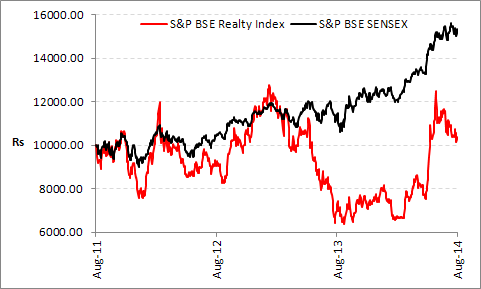
Base: Rs 10,000
Data as August 12, 2014
(Source: ACE MF, PersonalFN Research)
You see, the final guidelines on REITs were most awaited for long time by India’s real estate sector for its revitalisation. But its tax structure could be deterrent for participation by real estate companies. As we can see in the chart above, over a 3 year time horizon, even listed realty companies due to the broader fundamental undercurrents of the sector, mainly high cost of capital and pile of inventory in a high interest rate regime; have not only faltered vis-à-vis the S&P BSE Sensex over a 3-year time frame, but also shown a rollercoaster movement. And with an irritant tax structure for REITs, it appears unlikely there would be any change for good soon; unless interest rates start to decline which can help developers to turnover their inventory.
Should you invest in real estate through REITs?
PersonalFN is of the view that REITs is another investment avenue for you to diversify your portfolio. With a minimum investment of Rs 2 lakh you could participate in India’s the real estate market (through your unit holding in REITs), which is otherwise may not be possible to do while buying real estate physically. One worthy guideline from SEBI, that not less than 80% of the value of the REIT assets shall be in completed and revenue generating properties; will help you manage risk well as you would already be having exposure to projects that could generate revenues in future as well. Since the dividends (which are subject to DDT) which you earn are exempt in your hands as an investor, you could fetch you a better yield along with the capital gains you clock over period of time. Moreover, the liquidity will also not be an issue as they will be listed on a recognised stock exchange. But before you invest your hard earned money, it is vital for you to assess your risk appetite and take cognisance of the risk factors pertaining to India’s real estate sector.
Add Comments