Impact 
Monsoon mega discount offers start raining allover around this time of the year. Shopping malls and other retail outlets see higher footfall. Some banks and financial institutions too announce special borrowing schemes at teaser rates. If you were hoping to get any such offer this monsoon; there is some bad news for you. It is unlikely that, you are going to get any bargain deal this season.
Reason?
Borrowing cost is unlikely to go down significantly in the foreseeable future, at least in the Financial Year (FY) 2015-16. RBI chose to keep monetary policy rates unchanged at the third bi-monthly monetary policy review meeting conducted recently. Reviewing inflationary trends, liquidity conditions, impact of previous rate cuts on credit offtake and growth along with other macro-economic variables, RBI decided to maintain status quo on policy rates.
Retail Inflation: More Upside Left?
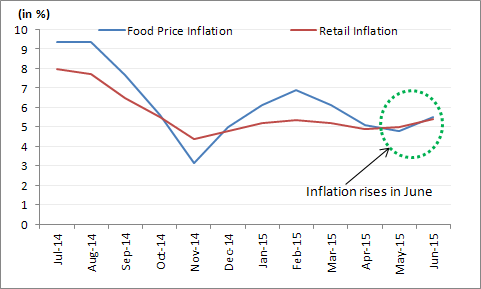
Data as on July 13, 2015
(MOSPI, PersonalFN Research)
Background to policy review
Since the second bi-monthly monetary policy review on June 03, 2015; global economy recovered modestly. While U.S. economy saw buoyancy marked by strong consumption and steadily improving conditions in job market, economic recovery in the Eurozone was moderate. Emerging market economies witnessed decelerating trend in economic growth.
As far as India is concerned, economic recovery has been under its way but has not picked up significantly just yet. Despite of higher imports in select items electronic goods, pulses, iron ore and fertilisers, trade deficit and the Current Account Deficit (CAD) remained lower. Consumption demand is seeing some revival, especially in the urban areas. Having said this, exports look still weak as global demand remains soft. Capex cycle has not gained vigour yet due low utilization of established capacities. Growth in services sectors remain mixed. RBI expects Indian economy to grow at 7.6% in FY 2015-16.
And the liquidity conditions….
There is ample liquidity in the system. As reveled by the RBI data, average daily liquidity infusion through various repos came down sharply from Rs 1.03 lakh crore in May to Rs 0.47 lakh crore in June. Dipping further in July, liquidity infusion averaged at Rs 0.12 lakh crore. Call rates also eased below repo rates suggesting the comfortable liquidity conditions.
Policy action…
On the basis of an assessment of the current and evolving macroeconomic situation, ZRBI decided to:
- Keep the policy repo rate under the liquidity adjustment facility (LAF) unchanged at 7.25 per cent;
- Keep the cash reserve ratio (CRR) of scheduled banks unchanged at 4.0 per cent of net demand and time liability (NDTL);
- Continue to provide liquidity under overnight repos at 0.25 per cent of bankwise NDTL at the LAF repo rate and liquidity under 14-day term repos as well as longer term repos of up to 0.75 per cent of NDTL of the banking system through auctions; and
- Continue with daily variable rate repos and reverse repos to smooth liquidity. Consequently, the reverse repo rate under the LAF will remain unchanged at 6.25 per cent, and the marginal standing facility (MSF) rate and the Bank Rate at 8.25 per cent
Policy rationale
- Although inflation still remains in the comfort zone, jump in the CPI reading registered in June suggests that, there are upside pressures
- Inflation in the non-food and non-fuel items remains a concern
- Impact of increase in the service tax is yet to be fully realised; and would be felt throughout the year; putting pressure on inflation
- Prices of some protein rich diets, pulses and oilseeds along with a few other food items have shot up in last few months
- As against the cut of 75bps (0.75 Percentage points) in policy rates; median lending rates of banks have gone down by 30bps so far. So no complete transmission has happened as yet
Citing these reasons RBI maintained rates unchanged at the third bi-monthly monetary policy stating that, "policy action was front-loaded in June; it is prudent to keep the policy rate unchanged at the current juncture while maintaining the accommodative stance of monetary policy. "
Monetary policy outlook
"Relative to the projections of the second bi-monthly statement, inflation projections in this bi-monthly statement are elevated by the higher than expected June observation but reduced by prospects of softer crude prices and a near-normal monsoon thus far. This implies that inflation projections for January-March 2016 are lower by about 0.2 per cent, with risks broadly balanced around the target of 6.0 per cent for January 2016."
"Several factors could have a significant mitigating influence on inflation. These include the sharp fall in crude prices since June and the likelihood of this softness persisting in view of the global supply glut and expanding production by Iran; the welcome increase in planting of pulses and oilseeds and prospects of rainfall in August and September according to some forecasters; the effects of the Government’s current pro-active supply management to contain shocks to food prices, especially of vegetables, alongside its decision to keep increases in minimum support prices moderate."
"Significant uncertainty will be resolved in the coming months, including the likely persistence of recent inflationary pressures, the full monsoon outturn, as well as possible Federal Reserve actions. As the Reserve Bank awaits greater transmission of its front-loaded past actions, it will monitor developments for emerging room for more accommodation."
Impact on markets
Yield on India’s 10-Year benchmark bond remain more or less unmoved by the policy stance of RBI. Moreover, equity markets too, after the initial negative reaction, have stabilized and remain range-bound, showing low impact of status quo maintained by the central bank.
What investors should do?
PersonalFN is of the view that, conditions set by the RBI to accord further rate cuts may take some time to fulfil. RBI expects banks to pass on full benefits of rate cuts; however, this is unlikely to happen soon as banks may find it difficult to substantially cut their deposit rates. Furthermore, in the wake of bad asset quality that prevails in the system, banks may go easy on lending. Having said this, re-capitalisation of public sector banks and full transmission of rate cuts announced so far, may help banks lend more.
RBI has acknowledged several pro-active measures taken by the Government in taking out supply side bottlenecks and initiating action on several fronts to curb food inflation but it is still concerned about structural problems relating to clogging of transmission grids and the dire financial state of electricity distribution companies.
For aforesaid reasons, PersonalFN believes, RBI may continue with its accommodative stance but may take longer than anticipated earlier to reduce policy rates. Investors shouldn’t speculate on further actions of the central bank and keep investing as guided in their financial plan. Moreover, PersonalFN also suggests that you should borrow only when it is really needed.
Add Comments