FMCG Funds on a fast track!
Despite the down-beat economic data from the U.S. and the situation of a “debt-overhang” in the Euro zone (especially in countries such as Greece, Ireland and Spain), the Indian equity markets in the year 2010 delivered appealing returns of 17.4%, as the FIIs exuded confidence in the Indian economy on account of luring economic growth rate. But during the same year (i.e. CY 2010) interestingly the BSE FMCG Index delivered a return of 32.0%, thereby outperforming the broader index (i.e. BSE Sensex) led by strong domestic consumption and consumer confidence. This wave of consumerism was also well-oiled by the job opportunities being created post the recession of 2008 and early 2009, rising income levels and FMCG companies attempting to increase their rural penetration. Moreover the good monsoons experienced by most parts of the country, also attributed to affordable input costs for most companies in the FMCG space.
In effect to these green shoots for the FMCG sector, the FMCG (mutual) funds performed handsomely well vis-a-vis diversified equity funds.
How FMCG Funds fared vis-a-vis Diversified Equity Funds
| Scheme Name |
1-Yr (%) |
2-Yr (%) |
3-Yr (%) |
5-Yr (%) |
Std. Dev. (%) |
Sharpe Ratio |
Top 10 stocks (%) |
Expense Ratio |
| FMCG Funds |
| SBI Magnum FMCG |
5.2 |
41.5 |
23.4 |
13.6 |
6.52 |
0.17 |
76.4 |
2.47 |
| Franklin FMCG (G) |
4.8 |
31.3 |
19.8 |
15.9 |
6.02 |
0.17 |
67.4 |
2.50 |
| ICICI Pru FMCG (G) |
2.5 |
21.6 |
8.8 |
13.5 |
7.51 |
0.03 |
83.4 |
2.50 |
| Category Average* |
4.2 |
31.5 |
17.4 |
14.4 |
6.68 |
0.12 |
- |
- |
| BSE FMCG |
10.1 |
27.9 |
19.1 |
15.9 |
6.68 |
0.12 |
- |
- |
| Diversified Equity Funds |
| HDFC Top 200 (G) |
5.1 |
19.9 |
12.1 |
20.8 |
9.34 |
0.07 |
43.5 |
1.79 |
| Franklin India Bluechip (G) |
6.2 |
17.2 |
8.9 |
18.3 |
8.78 |
0.03 |
48.0 |
1.83 |
| Canara Robeco Eq Diversified (G) |
1.4 |
15.1 |
8.9 |
17.2 |
9.89 |
0.03 |
39.4 |
2.32 |
| DSPBR Opp-Reg (G) |
3.6 |
18.4 |
4.8 |
16.6 |
9.19 |
-0.01 |
32.3 |
2.09 |
| Category Average* |
4.1 |
17.6 |
8.7 |
18.2 |
9.30 |
0.03 |
- |
- |
| BSE Sensex |
4.8 |
12.8 |
2.6 |
15.0 |
9.97 |
0.02 |
- |
- |
(NAV data is as on January 21, 2011. Standard Deviation and Sharpe ratio is calculated over a 3-Yr period. Risk-free rate is assumed to be 6.37%)
*Category average has been calculated taking into account the peers above
(Source: ACE MF, PersonalFN Research)
In fact when analysed over a 3 Yr time frame, they (FMCG funds) outperformed some good performing diversified equity funds (see table above) by managing their risk well (as revealed by their low Standard Deviation), and delivered enticing risk-adjusted returns as depicted by their high Sharpe Ratio. Moreover, the portfolio churning too hasn’t been high due to the evergreen prospects posed by most companies in the sector. But nonetheless the expense ratio has been relatively high compared to diversified equity funds. Also when assessed over for a 5 - Yr period, some good diversified equity funds have delivered better returns.
Characteristics of the Sector:
FMCG as a sector is quite defensive nature, which limits the wealth erosion during times of economic slowdown or during the bear phase of the equity markets. In fact in the table below it is evident that during the last bear phase of the Indian equity markets (i.e. from January 9, 2008 till March 9, 2009) the BSE FMCG index tumbled far lesser(-24.2%), when compared to the broader index – BSE Sensex (-55.4%). This in effect has also been displayed in the performance of FMCG funds vis-a-vis some good diversified equity funds.
Performance across market cycles
| Schemes and Index |
BULL |
BEAR |
BULL |
25-Aug-05
to
09-Jan- 08 |
09-Jan-08
to
09-March- 09 |
09-March-2009
to
31-Jan- 2011 |
| Diversified equity funds* |
51.9 |
-52.5 |
65.8 |
| FMCG Funds* |
26.2 |
-37.3 |
58.1 |
| BSE Sensex |
50.7 |
-55.4 |
57.1 |
| BSE FMCG Index |
29.5 |
-24.2 |
43.5 |
*Note: Average returns have been calculated of the peers above
(Source: ACE MF, PersonalFN Research)
In fact the chart below too depicts the defensiveness of the FMCG sector. In the year 2006 & 2007 when the Indian equity markets (BSE Sensex) were surging, the BSE FMCG lagged during the rally; but the downside was well arrested, as the consumption story was unhurt.
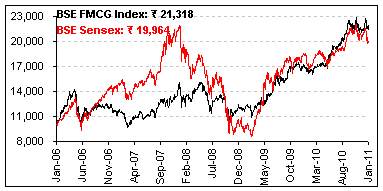
(Base: Rs 10,000)
(Source: ACE MF, PersonalFN Research)
So, if one were to invest Rs 10,000 in the BSE FMCG Index 5 years ago (i.e. on January 20, 2006), the same would have been worth Rs 21,318 on January 21, 2011, whereas a similar investment in the broader index – BSE Sensex would have yielded Rs 19,964.
Portfolio Strategy:
FMCG funds have fairly a concentrated portfolio of top 10 stocks on account limited stocks available under its ambit of selection. So if one peeps into the top 10 stocks of the FMCG funds, they would find ITC Ltd., HUL, Nestle Ltd., Pidilite Industries Ltd., Britannia Ltd., Marico Ltd., Tata Global Beverages Ltd., GSK Consumer Healthcare Ltd., Asian Paints Ltd. and Eveready Industries (India) Ltd. in their portfolio.
Dominant Sectors Sector Holdings
| Dominant Sectors |
% of holding* |
| Consumer Non Durables |
75.6 |
| Diversified |
7.6 |
| Chemicals |
6.3 |
| Textile |
2.7 |
| Retailing |
0.4 |
*Note: Sector holdings as December 31, 2010 of FMCG funds in the peer comparison table, have been taken for dominant sector calculation.
(Source: ACE MF,PersonalFN Research)
This thus indicates that FMCG funds also strongly ride along the wave of consumerism in the country. And a country like ours (which is less reliant on exports), where the consumption story is fairly strong enables the sector to perform well.
In a nutshell...
While overall the FMCG sector has performed well over the years backed by the strong consumption story, in our opinion the fortune of the FMCG funds is closely linked to its dominant sector holdings (which is 75% of its net assets). Moreover, as the stock selection universe is restricted, it leaves the fund manager with limitations of reducing the stock specific risk. Also, if FMCG funds are going to command a higher expense ratio (when compared to diversified equity funds), then it seems an unpalatable choice because their net assets are smaller (than diversified equity funds), which thus requires less resources for them to be managed. Also if one has a fairly longer time horizon 5 – 10 years, then the diversified equity funds are a much better option as they offer luring returns.
Add Comments