Impact 
India’s 10 prominent banks, in coordination to RBI, have launched the United Payment Interface (UPI) App. It is expected to cut the costs involved in making payments and users will be able to complete the transactions in lesser time. You may use this app for making any payment for the denomination below Rs 1 lakh.
At present, if you want to transfer money online, you need to first register the beneficiary and then feed in details such as the account number and IFSC code. However, with this new App, you will be able to complete the transaction by using the unique ID of the beneficiary and you can authenticate the deal by using a mobile pin.
More about UPI...
UPI will be a solitary interface throughout the National Payment Corporation Systems (NPCI). This will function on the Immediate Payment Service (IMPS) platform. UPI is expected to run as an alternative to debit cards, credit cards, and e-wallets. This App may take Indian banking system to a next level as it will use e-KYC, thanks to the high penetration of Aadhaar and would also make the use of digital lockers for keeping records. It will take customers’ affirmations through a digital platform and will also allow the use of digital signatures. However, it is still unclear that how the legal framework would be put in place for the new App. Currently, the card-base system has a well-established framework supported by agreements among merchants, fraud analytics, and grievance redressal agencies. We will have to wait for more clarity in case of UPI on this front.
Using UPI is a 5 step process. Here are the directions...
- Download the App from the Playstore
- Link the bank account to the App
- Create a Unique ID
- Link the Aadhaar to it
- Set a PIN
And you are ready to use the APP.
PersonalFN is of the view that, this revolutionary App may discourage the use of cash slowly and help the Government curb the black money circulation. This will cut the time taken for each transaction and will make it possible to transfers funds conveniently. However, you should make sure that, you don’t cross over your spending limits, and follow all safety instructions of the service provider. If run successfully, UPI may change how you move your money!
Impact
Foreign institutional Investors (FIIs) are always on a look out for better feed. They like active markets, growing economies, and stable currencies. India has been fitting their bill for past 2-3 years. In 2013 and 2014, India remained the most happening place for many global investors. Although the FIIs inflows were high even in the first half of 2015, they turned negative in the second half. Global investors were bullish on India ever since the Rupee started recovering from its August 2013 low. In 2014, the sentiment got more bullish since BJP presented Mr. Narendra Modi as its PM candidate for Lok Sabha Elections 2014.
However, the NDA Government has not achieved much of success under his leadership despite making efforts on several fronts. Corporate profits now suggest that recovery was never going to be as sharp as it was perceived. As Federal Reserve (Fed) talked of interest rate hikes and China lowered its currency, the Indian markets felt the heat as growth was still lacklustre and the sharp recovery was not in sight. This resulted in the FIIs stampeded in pre-budget sessions. The budget was probably the last chance for the Indian Government.
The government emphasized on the rural and agricultural development, as well as provided higher allocations to infrastructural development. Moreover, it also confirmed its commitment to containing the fiscal deficit to 3.5% in FY 2016-17.
Being content with these measures, the FIIs seem to have started returning to Indian markets, post budget.
Is Indian Market Set To Rally?
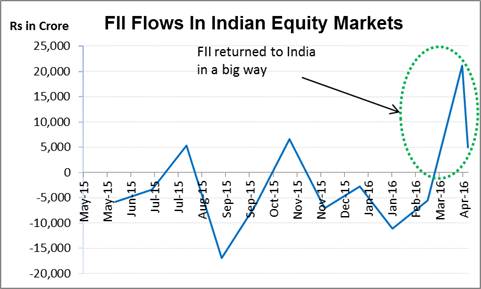
Data as on April 05, 2016
(Source: ACE MF, PersonalFN Research)
From time to time, PersonalFN has written about why individual investors should not follow FIIs. At present, other emerging markets such as Taiwanese and Brazilian are receiving higher foreign capital inflows are trading at much cheaper valuations as compared to India. Although FIIs remain bullish in India even now, as denoted by the lowest fall they recorded among major emerging markets in 2015, incremental FII flows have become hard to come by.
To ready more about this story and Personal FN’s views over it, please click here.
Impact
While many foreign mutual fund houses are exiting India, finding it unviable to run businesses profitably, we are now seeing new domestic fund houses entering in the game. Mahindra Asset Management Company, which is a wholly owned subsidiary of Mahindra and Mahindra Financial Services (MMFS), recently received the approval of the Securities and Exchange Board of India (SEBI) to start operations.
For years, the mutual fund industry has failed to expand markets beyond the top 15 cities in the country. Most of its business comes from the Western region, however, the trend has changed lately. In the last Financial Year (FY), smaller cities accounted for about 44% of the new business. Newly launched Mahindra Mutual Fund has chalked out a unique strategy to grow. It has decided to focus on semi-urban and rural areas. Its parent company MMFS has a presence in more than 2 lakh Indian villages. It seems that Mahindra Mutual Fund aims to bank on this network and wants to extend its existing client relationships to managing investments (from offering loans).
To ready more about this story and Personal FN’s views over it, please click here.
Impact One ought never to turn one's back on a threatened danger and try to run away from it. If you do that, you will double the danger. But if you meet it promptly and without flinching, you will reduce the danger by half— Sir Winston Churchill
This piece of advice seems to be very apt for mutual fund houses given the present situation. Debt schemes offered by mutual fund houses are gripped with the problem of heightened credit risk. Instead of taking it head on, they want to quarantine the virus. The Securities and Exchange Board of India (SEBI) does not approve of this approach of quarantining the troubled part of the portfolio of debt mutual schemes.
If you remember, JP Morgan Mutual Fund had hived off its troubled assets from the rest of the portfolio under its two schemes that were down by the default of Amtek Auto. PersonaFN had covered this story extensively. Although there wasn’t a reported default after that, the mutual fund industry has been facing a risk of deteriorating credit quality. Jindal Steel and Power Limited (JSPL) gave sleepless nights to mutual fund houses. Hoping to curtail such cases to reoccur, mutual fund houses approached the SEBI with a request to permit the creation of ‘side pockets.' Side pocketing is nothing but separating troubled, illiquid, and unyielding debt securities from the rest of the portfolio.
To ready more about this story and PersonalFN’s views over it, please click here.
|
| © Quantum Information Services Pvt. Ltd. All rights reserved.
Any act of copying, reproducing or distributing this newsletter whether wholly or in part, for any purpose without the permission of PersonalFN is strictly prohibited and shall be deemed to be copyright infringement.
Disclaimer: Quantum Information Services Pvt. Limited (PersonalFN) is not providing any investment advice through this service and, does not constitute or is not intended to constitute an offer to buy or sell, or a solicitation to an offer to buy or sell financial products, units or securities. All content and information is provided on an 'As Is' basis by PersonalFN. Information herein is believed to be reliable but PersonalFN does not warrant its completeness or accuracy and expressly disclaims all warranties and conditions of any kind, whether express or implied. PersonalFN and its subsidiaries / affiliates / sponsors or employees, personnel, directors will not be responsible for any direct / indirect loss or liability incurred by the user as a consequence of him or any other person on his behalf taking any investment decisions based on the contents and information provided herein. This is not a specific advisory service to meet the requirements of a specific client. Use of this information is at the user's own risk. The user must make his own investment decisions based on his specific investment objective and financial position and using such independent advisors as he believes necessary. All intellectual property rights emerging from this newsletter are and shall remain with PersonalFN. This is for your personal use and you shall not resell, copy, or redistribute this newsletter or any part of it, or use it for any commercial purpose. The performance data quoted represents past performance and does not guarantee future results. As a condition to accessing PersonalFN's content and website, you agree to our Terms and Conditions of Use, available here.
Quantum Information Services Private Limited Regd. Office: 103, Regent Chambers, 1st Floor, Nariman Point, Mumbai - 400 021 Corp. Office: 101 Raheja Chambers, 213, Free Press Journal Marg, Nariman Point, Mumbai 400021. Email: info@personalfn.com Website: www.personalfn.com Tel.: 022 61361200 Fax.: 022 61361222 CIN: U65990MH1989PTC054667 |