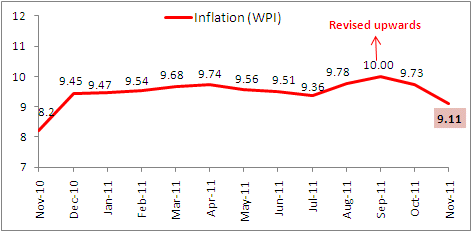
The Wholesale Price Index (WPI) inflation for November 2011 mellowed to a 12 month low of 9.11%, thus taking a 62 basis points descending move from the data registered in the previous month. The fall in headline inflation mainly occurred as food inflation landed below the double-digit terrain to 8.54% in November 2011 (from 11.06% registered in the previous month).
But interestingly if we assess the stubbornness in WPI inflation is still evident as it continues to be over the 9.00% mark for consecutive 12 months, and is still above the 6.00% - 7.00% comfort range of the Reserve Bank of India (RBI).
The inflation bug!
(Source: Office of the Economic Advisor, PersonalFN Research)
At present while many economists expect WPI inflation for December 2011 to be around 8.00%, we think that the present fall in the Indian rupee, would dampen those expectations. It is noteworthy that that the crash of the Indian rupee to a life time low of 54.00 per U.S. dollar is leaving a lasting scar on the Indian economy as well as the corporates. Citizens too are already feeling the pinch of high prices, and have little hope of relief as it would now elevate the chances of imported inflation. The Indian rupee has been the worst performing currency in Asia with a fall of -21% since August 2011. Currencies of other emerging economies are also falling, but the depreciation of the Indian rupee has been rather steep due to contraction in the industrial output and battered Government finances on account of turbulence in the currency markets steered by Euro zone debt crisis.
The increase in petrol price effected in September 2011 by oil marketing companies to correct their under recoveries is still reflecting stickiness in fuel inflation for October 2011 (as it stands at 15.48%). Moreover, elevated borrowing cost and surge in input cost is also pushing manufacturing inflation, which stood at 7.7% for October 2011.
So, would RBI take a pause in rate hikes?
Fighting hard with the inflation monster, the Reserve Bank of India (RBI) has been inflexibly increasing the key interest rates consecutively for 13 times now.
Policy rate tracker
|
Increase / (Decrease) since March 2010 |
At present |
| Repo Rate |
375 bps |
8.50% |
| Reverse Repo Rate |
425 bps |
7.50% |
| Cash Reserve Ratio |
100 bps |
6.00% |
| Statutory Liquidity Ratio |
(100 bps) |
24.00% |
| Bank Rate |
Unchanged |
6.00% |
(Source: RBI website, PersonalFN Research)
But with the descending move displayed by WPI inflation for November 2011, the central bank may get the encouragement to press the pause button in its 3rd quarter mid-review of monetary policy 2011-12 (scheduled on December 16, 2011), given the confluence of following economic factors:
- Slump in industrial output: The Index of Industrial Production (IIP) for the month of October 2011 (data released in December 2011) plunged sharply to -5.1% after showing a dismal growth of 2.0% (earlier figure of 1.9%) as reported in the previous month. Moreover, it has displayed a southward trend since the October last year. The production of capital goods falling sharply by 25.5% in October 2011 is a worrisome signal, along with a negative annual growth of 6.0% in manufacturing index.
- Falling GDP growth rate: India’s economic growth for the second quarter of the fiscal year 2011-12 has fallen to 2-year low of 6.9% from 7.7% clocked in the previous quarter of the fiscal year.
- Expectation of fuel inflation to cool: The two successive downward revisions in petrol prices brought in by oil marketing companies in November 2011 (after Brent crude displayed a corrective phase) raises hopes that fuel inflation may cool going forward.
- Tight liquidity in the system: The tight liquidity in the system due to advance tax payment schedule may also preclude a policy rate hike. However in order to ease the liquidity in the system (due to advance tax payment schedule) a reduction of 25 bps can be expected in the Cash Reserve Ratio (CRR).
Our View on inflation:
We believe that the December 2011 inflation data is unlikely to come down because, the falling Indian rupee display a detrimental impact as explained above. But assessing the fact we have had above normal monsoon we expect food inflation to mellow, which may thus aid in pulling down WPI inflation as well. However, fuel prices should remain under check. If things pan out positively, we expect WPI inflation to be in the range of 7.00% - 7.50% by March 2012.
What should equity investors do?
Equity investors should adopt calm and compose approach by staying invested and also investing further as, valuations in the Indian equity markets look fairly attractive and there is potential for robust future growth.
However, as fear of downbeat economic data being disseminated from the Euro zone still remains, staggering your investments would be an appropriate approach. We recommend that you invest in diversified equity funds as this will help reduce risk. However one should stay away from U.S. or Euro oriented offshore funds in such a scenario, and instead look at investing in domestic value style equity funds. Ideally you should opt for the SIP (Systematic Investment Plan) mode of investing as this will help you to manage the volatility of the equity markets well (through rupee-cost averaging) and also provide your investments with the power of compounding .
Remember, while investing select only those equity funds which follow strong investment processes and systems, and invest with a long-term horizon of at least 5 years.
What should debt investors do?
Well, we think that the current situation is attractive to take exposure to debt mutual fund instruments as interest rates are likely to consolidate at these higher levels before they start going down.
You can now gradually take exposure to pure income and short-term Government securities funds. Since longer tenor papers will become attractive, longer duration funds (preferably through dynamic bond / flexi-debt funds) can be also considered, if one has a longer investment horizon (of say 2 to 3 years). However, one may witness some volatility in the near term as there is always an interest rate risk associated with the longer maturity instruments.
With liquidity in the system being tight (ahead of advance tax payment obligation in mid-December), yield on the short term instruments are expected to move up slightly (say by 15 bps to 25 bps) thus making short term papers more attractive. Hence investors with a short-term time horizon (of less than 3 months) would be better-off investing in liquid funds for the next 1 month or liquid plus funds for next 3 to 6 months horizon. However, investors with a medium term investment horizon (of over 6 months), may allocate their investments to floating rate funds. Short term income funds should be held strictly with a 1 year time horizon.
Fixed Maturity Plans (FMPs) of 3 months to 1 year will yield appealing returns and can also be considered as an option to bank FDs only if you are willing to hold it till maturity, but you may not have a very attractive post tax benefit, as indexation benefit will not be available on FMPs maturing within 4 months. You should invest in longer duration funds, if the time horizon is of over 2 to 3 years. You can consider investing your money in Fixed Deposits (FDs). At present 1 yr. FDs are offering interest in the range of 7.25% - 9.40% p.a.
What should investors in gold do?
With the global economy being on an edge with the debt-overhang situation in the Euro zone, the risk of a contagion spreading still remains. This we think would make the precious yellow metal continue its northward journey, with sideways movement as well, if some intermediate positive news is disseminated from the Euro zone. Moreover, as long as WPI inflation continues to remains stubborn we think that smart investors would prefer to take refuge under the precious yellow metal, thus hedging themselves against prices.
Hence, nothing has changed for gold and we believe it will continue to maintain its upward trend in the long-term.
Add Comments
| Comments |
klcd2ziqz@outlook.com
Jan 07, 2015
Begun, the great internet edauction has. |
support@scoalawww.com
Jan 19, 2012
When you think about it, that's got to be the right answer. |
1