 |
| July 25, 2014 |
|
| Weekly Facts |
|
Close |
Change |
%Change |
| BSE Sensex* |
26,126.75 |
485.19 |
1.89% |
| Re/US$ |
60.11 |
0.07 |
0.12% |
| Gold Rs/10g |
28,090.00 |
-60 |
-0.21% |
| Crude ($/barrel) |
106.85 |
1.56 |
1.48% |
| FD Rates (1-Yr) |
8.00% - 9.00% |
Weekly change as on July 24, 2014
*BSE Sensex as on July 25, 2014
|
Impact 
Brand names matter to many of us. Whether you are buying toothpaste or buying your next cell phone, you would always first look for products of well-known companies. Some companies create such a huge business empire aided by the brand equity exercise, that their influence on the economy is very high. If they are doing well, economy tends to do well. But if something happens to them then there is a huge economic setback in the entire country. Such "too big to fail" organisations sometimes become prestige points for a country. A country cannot afford to let such giants go under water. Like in the case of United States, it was "American International Group (AIG)" in 2008. This is just one example...there are many such companies which Governments have to save to avoid catastrophic impact on economy. If the company is a financial institution such as a bank, impact would be even higher on account of its eminence.
Indian Scenario:
In India, although banks are tightly regulated, RBI doesn't want to take any half measures. Keeping in mind horrific global experiences of letting large banking institutions grow in an unrestrained manner, RBI is keen on following disciplined approach. Recently, it suggested that, it would identify 6 Systematically Important Banks (SIBs) by August 2015. The basic criterion for the selection of such banks will be their size. Banks which have a size of in excess of 2% of GDP would be an important factor for deciding, whether the banks is SIB or not. Other factors include:
- Interconnectedness
- Lack of readily available substitutes
- Financial institution infrastructure
- Complexity
What will change for SIBs
Once the bank is identified as SIB, it will have to commit more capital per loan, which may fall in the range of 0.2% to 0.8%. So it can be said SIBs will be have to keep aside more capital However, it is unlikely that their business or profitability would be affected to any great extent. Thus big banks such as State Bank of India (SBI), HDFC bank or ICICI bank may easily qualify as SIBs, with adequate capital at their recourse.
PersonalFN is of the view that, RBI is moving in the right direction. Maintaining balance between capital and loan disbursal may help avoid unpleasant situations. However, over emphasis on size of a bank may take focus off from the important issue of NPAs. Political influence in the banking system and possible lapse on account of poor credit assessment would remain unanswered if no specific measures are taken. PJ Nayak committee has made some good suggestions to improve functioning of public sector banks and tried addressing functioning related issues of public sector banks. SIBs should be imposed with tighter measures on controlling NPAs and improving quality of assets. Having said this, RBI may also look at speculative tilt of banks and consider derivative exposure of banks while shortlisting SIBs. PersonalFN is of the view that, this initiative of RBI may help Indian banking system become stronger.
Do you think keeping aside more capital will safeguard "too big to fail banks"? Share your views
|
Impact
Driving a car or a motor bike may give you joy. If you own a vehicle, you are saved from hassle of commuting by public transport; which is often overcrowded and in a bad state. But mind you, owning a vehicle invites some responsibilities as well, such timely renewal of PUC certificate, maintenance and most importantly - motor insurance. If you are one who often forgets the date when your motor insurance expires, here's some good news for you.
The Insurance Regulatory and Development Authority (IRDA) is mulling over allowing insurers to issue one time 5-Year policies and may soon issue new guidelines in this regard. To begin with, the cover may be allowed for two wheelers. Nevertheless there are proposals that the regulator should approve such a long-term cover for commercial vehicles and mini utility vehicles (MUVs) as well.
It is believed that issuing long term policies would help insurance companies increase insurance penetration. As per the latest data, general insurance penetration in India stands at 0.78%. The amount of premium collected in motor segment was Rs 29, 777 crore in 2012-13. It has also been suggested that such policies should also be linked to registration and fitness certificates.
PersonalFN is of the view that, although there are certain benefits of issuing long-term insurance policies there are a few nitty-gritties, as to how the product will be priced and adjustment for 'No Claim Bonus (NCB)'. Having said this, it appears that policyholders of such a product would gain. This is because; the premium amount is expected to be lower in comparison to motor insurance policies which ask for annual renewals. Also this would be a convenient, as against setting reminders for annual renewal and doling out premium cheques every year.
Notwithstanding the above, PersonalFN is of the view that it is important to have a good judgement of frequency and quantum of claims since it would be least preferred that claim amount exceeds premiums received. Currently, there are about 10 lakh outstanding claims on third party motor insurance which amount nearly to Rs 22,000 crore.
PersonalFN is of the view that, irrespective of how safe you drive you it is imperative to have a comprehensive car insurance and not only be happy paying less for 'third party insurance', which is mandatory. You see, don't be penny wise pound foolish. To simply put, you may end eroding your savings and / or investments if you damage your vehicle in an accident and do not have a comprehensive policy to get your vehicle back in the right shape and performance.
So on that note, we wish you happy, safe and pleasurable driving / riding ...and we'll keep you abreast on this news with our views as the IRDA comes up with guidelines on such a product.
|
FREE Money Simplified Guide
Your Definitive Guide To Retirement Planning!
Download your FREE copy to know how you can indeed build the corpus for your golden years.
Click Here to get this most downloaded E-Guide, Now!
|
|
Impact
Monsoon might be weak this season but there is a flood of foreign capital in Indian equity markets this year. In the year 2014, markets have touched all-time high. S&P BSE Sensex crossed 26,000 in pre-budget sessions, before profit taking brought the index down. Nonetheless, S&P BSE Sensex regained the 26,000 level recently.
FIIs driven market rally
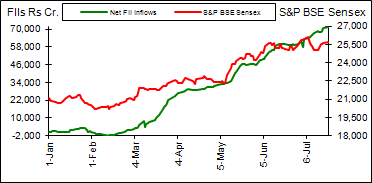
Data as on July 21, 2014
(Source: Office of the Economic Advisor, PersonalFN Research)
Foreign Institutional Investors (FIIs) have remained upbeat on India from the beginning of this year. They have invested about Rs 71,000 crore in 2014 so far. Foreign investors have gone gung-ho on India expecting that NDA Government will introduce and implement reformist policies. Till a fortnight ago it seemed like draught woes may impact market sentiment and FII flows may be interrupted. However, strong revival of monsoon in many parts of India has brought down rain deficit to 27% (according to the Indian Meteorological Department). Rain deficit in June was as high as 41%. This has resulted in improved market sentiment. FII flows have been strong even post budget. Many of you may be wondering how long FIIs will keep buying Indian equities and which way the market would pave path going forward.
To read more about this story, please click here.
|
Impact
Many of you might have invested in debt funds since they received favourable tax treatment. Those falling in the higher tax bracket had a chance of generating a higher post-tax return, as against that generated by Fixed Deposits (FDs).
But now that after budget 2014-15 as debt funds seem to have lost appeal, you may be thinking about shunning long-term investments in debt funds. The finance minister has increased the rate of long term capital gain tax from 10% to 20% (possibly with indexation) on transfer of units of other than equity oriented funds. Thus the rate of 10% without indexation is completely done away with. Likewise, the holding period for such purpose and for it to be classified as Long Term Capital Gain (LTCG) is also increased from 12 months to 36 months. You see, although this move is primarily aimed at removing the tax arbitrage which existed between FDs and Fixed Maturity Plans (FMPs) due to favourable tax treatment to latter; it has affected a number of retail investors of open-ended debt mutual funds.
Now that debt mutual funds have lost their appeal, it is perceived that arbitrage funds would be a close substitute to debt funds, especially to those who are looking to receive favourable tax treatment but yet earn returns comparable to those generated by debt funds. So is it really a substitute? Well, before analyse that let's first understand how does an arbitrage fund work.
To read more about this news and PersonalFN's views on it, please click here.
|
- This is a tax return filing season. Many of you must be consulting a tax practitioner for declaring your income to the Government. It's a routine that a tax consultant helps you compute your total income from various sources, claim deductions, if any and finalise tax liability. Extending their services, many tax practitioners, file tax returns (including e-returns well) on behalf of their clients. Moreover, they provide e-mail addresses of their own, so that they can easily take requisite action in case tax department raises any query. This takes off a lot of pressure on you as an assessee and not confronting to regular procedures and correspondences. But soon this will not be case now.
Recently, Central Board of Direct Taxes (CBDT) has issued a directive making it mandatory for all tax payers to register their e-mail address and cell phone numbers while filing e-returns. This is expected to let tax officials communicate directly with the assessee. This initiative has been taken with a view that it may make the system more transparent and would be a remedial step against corrupt practices.
So now onwards, important communication such as notices, demands and refund orders, will be sent on the assessees email id. This may trouble those who don't have email account or who do not check mails regularly. Furthermore, the same mail address can't be used by more than 10 accounts. So this is clearly going to increase the work load of tax practitioner and call for more co-ordinated and responsible effort from the assesse as well.
PersonalFN is of the view that direct communication with assessees is a welcome move. However, considering the lesser penetration of internet in India and its spread remaining restricted only in top cities, it might be initially difficult to achieve the aim. Having said this, if enough awareness is created, direct communication would help bring down corruption and make assessees take tax filing more seriously.
|
Too Big To Fail: The idea that a business has become so large and ingrained in the economy that a government will provide assistance to prevent its failure. "Too big to fail" describes the belief that if an enormous company fails, it will have a disastrous ripple effect throughout the economy.
(Source: Investopedia)
|
Quote : "The hardest thing to judge is what level of risk is safe" - George Soros
|
|
|
|
© Quantum Information Services Pvt. Ltd. All rights reserved. Any act of copying, reproducing or distributing this newsletter whether wholly or in part, for any purpose without the permission of PersonalFN is strictly prohibited and shall be deemed to be copyright infringement.
Disclaimer: Quantum Information Services Pvt. Limited (PersonalFN) is not providing any investment advice through this service and, does not constitute or is not intended to constitute an offer to buy or sell, or a solicitation to an offer to buy or sell financial products, units or securities. All content and information is provided on an 'As Is' basis by PersonalFN. Information herein is believed to be reliable but PersonalFN does not warrant its completeness or accuracy and expressly disclaims all warranties and conditions of any kind, whether express or implied. PersonalFN and its subsidiaries / affiliates / sponsors or employees, personnel, directors will not be responsible for any direct / indirect loss or liability incurred by the user as a consequence of him or any other person on his behalf taking any investment decisions based on the contents and information provided herein. This is not a specific advisory service to meet the requirements of a specific client. Use of this information is at the user's own risk. The user must make his own investment decisions based on his specific investment objective and financial position and using such independent advisors as he believes necessary. All intellectual property rights emerging from this newsletter are and shall remain with PersonalFN. This is for your personal use and you shall not resell, copy, or redistribute this newsletter or any part of it, or use it for any commercial purpose. The performance data quoted represents past performance and does not guarantee future results. As a condition to accessing PersonalFN's content and website, you agree to our Terms and Conditions of Use, available here.
Quantum Information Services Pvt. Ltd. 101, Raheja Chambers, 213, Nariman Point, Mumbai - 400021. Tel: +91 22 6136 1200
Website : www.personalfn.com CIN: U65990MH1989PTC054667
|