Impact 
 In an effort to impart unbiased information to the policyholders, the Insurance Regulatory and Development Authority (IRDA) banned product comparisons put up by insurance aggregators on their portals. The IRDA further clarified that web aggregators shall not display ratings, rankings, endorsements or bestsellers of insurance products on their website. The content of the websites of the web aggregators shall be unbiased and factual in nature; they shall desist from commenting on insurers or their products in their editorials or at any other location in their websites.
The IRDA circular also proposes several other stringent guidelines for web aggregators, including restrictions on all kinds of advertisements and sponsored content. Until now, web aggregators earned  80 - 90 per lead from the insurer or broker, irrespective of whether it led to an actual sale. This has been reduced to 10 per lead by IRDA. Moreover, it was not mandatory earlier for a web portal to register with the regulator, but now the new guidelines emphasise the need for registration with a fee of 10,000 for three years. Alternatively, the insurance company or broker can pay the aggregator a flat fee not exceeding 1 lakh per year towards each product displayed by it in the comparison charts of its website. 80 - 90 per lead from the insurer or broker, irrespective of whether it led to an actual sale. This has been reduced to 10 per lead by IRDA. Moreover, it was not mandatory earlier for a web portal to register with the regulator, but now the new guidelines emphasise the need for registration with a fee of 10,000 for three years. Alternatively, the insurance company or broker can pay the aggregator a flat fee not exceeding 1 lakh per year towards each product displayed by it in the comparison charts of its website.
We believe that the initiative by the IRDA will go a long way in helping the policyholders to select the right insurance product for them through unbiased information. But while buying an insurance policy we also believe, that one must also read the offer document well before opting for a policy through information provided only by aggregators.
| Multibagger Stock Ideas
Claim this Free & Exclusive Guide Today. Act Now!
CLICK HERE to know more... | | |
Impact
 Earlier in August 2011, the Securities and Exchange Board of India (SEBI) directed mutual fund houses to conduct a due diligence process on 500-odd top distributors and Independent Financial Advisors (IFAs) across the country. The capital market regulator directed that mutual fund distributors with presence across 20 locations, or those who have received fees over 1 crore, or the ones who have got commission in excess of 50 lakh from one mutual fund to be audited by the mutual fund houses.
However seeing resentment from the mutual fund distributors and IFAs, fund houses through their industry body – Association of Mutual Funds in India (AMFI) requested the capital markets regulator to allow them to appoint an external consultant to conduct the audit on their behalf due to protests from distributors. But SEBI recently shot down a suggestion by Asset Management Companies (AMCs) to appoint an external agency to audit mutual fund distributors and IFAs. Thus now the mutual funds’ audit teams will mainly look into the revenues along with regulatory records of these distributors, and would be supposed to review associate and subsidiary businesses of distributors.
We believe that that this move is attempted to make mutual funds directly responsible for distributors, and thus would infuse transparency in the way mutual fund industry operates. However, distributors and IFAs should co-operate and take this move in the right spirit by overcoming the anxiety of disclosing their revenues to the world.
| | Impact
India’s economic growth for the second quarter of the fiscal year 2011-12 slumped to 2-year low of 6.9% (from 7.7% clocked in the previous quarter of the fiscal year).
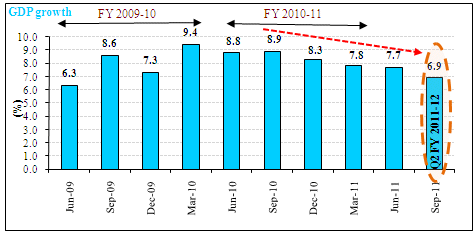
(Source :Office of Economic Advisor, PersonalFN Research)
Weakness in the second quarter was broad-based, with manufacturing growing at only 2.7% (against 7.2% clocked in the previous quarter), farm output expanding by only 3.2% (against 3.9% clocked in the previous quarter) and mining contracting to 2.9%.
We believe that the Indian economy has undergone a confluence of factors in the last one year. Primarily WPI inflation has remained sticky and above the comfort levels of the Reserve Bank of India (RBI), which in turn has resulted in them adopting anti-inflationary stance in the monetary policy. Cost of funds too have gone up due to 13 successive policy rate hikes brought in by the central bank (to tame inflation) which in turn has weighed heavily on the economic growth rate.
Going forward we believe that Index of Industrial Production (IIP) numbers would have to watched carefully to take cue of the momentum in economic growth rate. But having said that, we are of the view that as long as our economic growth rate is +6.5% year-on-year on an average, there is not much to worry as it would entice Foreign Institutional Investors (FIIs) to look at India (amongst the other emerging market economies); in a situation where economic growth rate clocked by the developed economies is dismal.
Speaking about RBI future monetary policy stance (in the third quarter mid-review of Monetary Policy 2011-12), we believe that they would refrain from increasing policy rates once again, looking at the Q2FY12 GDP growth rate. Also going forward, WPI inflation data which have been on the radar of the central bank (to draw its monetary policy), is expected to mellow given the fact that above normal monsoon have aided to push food inflation below the double-digit terrain.
To know what you as investors’ should do, click here.
| | | | Weekly Facts |
| Close | Change | %Change | | BSE Sensex* | 16,846.83 | 1151.4  | 7.34% | | Re/US$ | 51.47 | 0.6 | 1.06% | Gold /10g /10g | 29,050.00 | 410.0 | 1.43% | | Crude ($/barrel) | 111.32 | 4.1 | 3.81% | | FD Rates (1-Yr) | 7.25% - 9.40% | Weekly change as on December 01, 2011
*BSE Sensex as on December 01, 2011 | | | | This Week's Poll !!!
************
Do you compare various insurance policies on factual information before making a final choice? To Vote Now!
| |
In an interview with the Mint, Mr. Indranil Sengupta - Chief India Economist at Bank of America-Merrill Lynch, shared his views on GDP growth in India, major concerns for India, its fiscal deficit and RBI’s stance on policy rates.
Mr. Sengupta believes that if the United States goes into recession (having a 40% probability) the Gross Domestic Product (GDP) of India will grow at 6% instead of 7.2%.
Speaking about the major concerns for India are concerned, he believes that it boils down to two things. “One is oil; all the problems of inflation, of the current account deficit, of the fiscal deficit, have as of now one word, which is oil. So that's pretty much global. The second thing is that business confidence is clearly low all over the world, including India, and if you see the kind of turmoil that everyone is going through, it's not surprising that you see capex being pushed backwards in almost all countries,” he explained.
Mr. Sengupta is of the view that the fiscal deficit of India would be somewhere around 5.8% of GDP. “Let's see where the rupee goes eventually because these are very volatile times, but clearly a 10% move in the rupee, for example, will probably have a 20 basis point impact on the fiscal deficit in terms of the oil subsidy. But yes, I mean, we have been saying right since February that the fiscal deficit will overshoot the target,” he said.
In his opinion, the Reserve Bank of India (RBI) should not hike rate further, after having raised policy rates for 13 consecutive times. “I think the impact of rupee depreciation on inflation till March will probably be somewhere between 30-50 basis points. After the UP (Uttar Pradesh) elections when you get the diesel price hike, you will get the balance impact of around 50-75 basis points. I doubt whether this in itself would be a cause for RBI to hike rates because I think right now the way things are, if inflation comes down and allows RBI to cut rates, then growth worries will come off and the rupee will appreciate. Hiking rates at this point in time is not in any way the answer,” he said.
| |
Fiscal Deficit: When a Government's total expenditures exceed the revenue that it generates (excluding money from borrowings). Deficit differs from debt, which is an accumulation of yearly deficits.
(Source: Investopedia) | | | QUOTE OF THE WEEK
"Focusing your life solely on making a buck shows a poverty of ambition. It asks too little of yourself. And it will leave you unfulfilled."
- Barack Obama | | |