RBI turns hawkish to tame the inflation bug: Monetary Policy 2011-12
The Reserve Bank of India (RBI) in its Monetary Policy Statement 2011-12 took a hawkish measure moving away from the calibrated exit stance (of 8 successive policy rate hikes) adopted in the fiscal year 2010-11. The central bank raised the key policy rates by 50 basis points as resurgence of inflation was once again exhibited in the last quarter of the fiscal year 2010-11. The rate hike was despite lower growth of 15.9% (as against RBI’s indicative trajectory of 17.0%) in broad money supply (called M3 in economic terms) due to slow deposit growth and acceleration in currency growth.
Thus now the policy rates are as under:
Repo rate increased by 50 basis points from 6.75% to 7.25%; and
Reverse Repo rate increased by 50 basis points from 5.75% to 6.25%
Thereby maintaining the Liquidity Adjustment Facility (LAF) corridor between repo and reverse repo rate at 100 basis points.
However assessing the broad money supply growth which in turn did not contribute to the resurgence in WPI inflation, the Cash Reserve Ratio (CRR) is kept unchanged at 6.00%.
[PersonalFN expected policy rates (both repo as well as the reverse repo) to increase by 25 basis points, in a move to tame inflation, without hurting economic growth].
Statutory Liquidity Ratio (SLR) has also been kept unchanged at its last reduced level of 24% (In the third quarter mid-review of monetary policy 2010-11 on December 16, 2010, SLR was reduced from 25% to 24%).
Bank rate too has been left unchanged at 6.00%.
However, interest rate on savings bank account is raised from 3.5% to 4.0% while the discussion paper on deregulating saving bank account interest rates is placed for feedback (on RBI’s website) from the general public.
Hence if we assess this has been the 9th successive increase since March 2010, where now the hike in the repo rate and the reverse repo rate has been 250 basis and 300 basis points respectively.
Reason for such a policy stance:
Inflationary pressures
As mentioned earlier the resurgence in the WPI inflation witnessed in the last quarter of the fiscal year 2010-11 has caused this hawkish stance. The RBI is at present worried about inflationary pressures building on account of non-food items contributing to the up-move in inflation. Moreover, elevation in commodity prices headed by Brent crude oil is at present causing inflation to remain sticky and is also accentuating inflationary pressures in Emerging Market Economies (EMEs).
Brent crude oil at present is trading over the US $ 120 per barrel mark, and with expectations of demand increasing the upward bias in the oil prices still remains. Also with the geo-political unrest in the MENA (Middle East North Africa) region, the chance of them (oil prices) moderating look weak.
In India if fuel prices are increased to correct the under-recoveries of oil distribution companies, then that may ignite WPI inflation. At present India’s fuel price index has galloped to 13.53% (in the year to April 16, 2011) which is a cause of worry.
India’s headline WPI inflation has certainly pinched the pockets of the common man as it still remains over 8.00% - the comfort level of the RBI (at 8.98% in the month of March 2011– data release in April 2011).
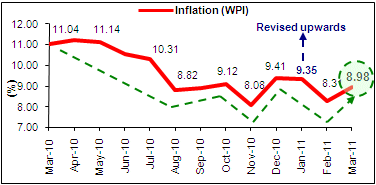
(Source: Office of Economic Advisor, PersonalFN Research)
But with the expectation of south west monsoon to be normal (according to the RBI), its impact on moderation in food inflation may be less than commensurate, given a strong structural component in food inflation and elevated global food price situation. However having said that, even though demand side pressures persist (which has induced generalisation of commodity prices in the recent months), signs of moderation in growth suggest that this driver of inflation will ease in the coming months. Hence keeping in view the domestic demand-supply balance and the global trends in commodity prices and the likely demand scenario, the baseline projection for WPI inflation for March 2012 is placed at 6.00% with an upward bias. Inflation is expected to remain at an elevated level in the first half of the year due to expected pass-through of increase in international petroleum product prices to domestic prices and continued pass-through of high input prices into manufactured products.
(PersonalFN’s forecast for inflation range is 7.00% - 7.50% by March 2012)
Thus against this backdrop, the stance of monetary policy of the Reserve Bank will be as follows:
- Maintain an interest rate environment that moderates inflation and anchors inflation expectations
- Foster an environment of price stability that is conducive to sustaining growth in the medium-term coupled with financial stability
- Manage liquidity to ensure that it remains broadly in balance, with neither a large surplus diluting monetary transmission nor a large deficit choking off fund flows
Expected outcome from the policy stance:
The central bank’s stance of increasing policy rates by 50 basis points is expected to:
- Contain inflation by reining in demand side pressures, and anchor inflationary expectations; and
- Sustain the growth in the medium-term by containing inflation
What does the policy stance mean and its impact?
The repo rate is the rate of interest charged by the central bank on borrowings by the commercial banks. Increasing repo rate means, there will be increase in the borrowing cost of commercial banks. Hence as a reaction to such a move, cost of borrowing for individuals and corporates may go up, as the commercial banks in the country may hike lending rates further.
Similarly, the interest rates on fixed deposits are also expected to move upwards from the current levels. At present 1 yr FDs (Fixed Deposits) are offering interest in the range of 7.00% - 9.25% p.a.
The reverse repo rate is the rate of interest, at which the banks park their surplus money with the central bank. Increasing them will result in commercial banks continuing to enjoy higher interest rates for parking their surplus funds with RBI.
The Statutory Liquid Ratio (SLR) is the amount that the commercial banks require to maintain in the form of cash, or gold or govt. approved securities before providing credit to the customers. Keeping them unchanged would help in keeping a check on the prevailing surplus liquidity situation.
The savings bank account enables many investors to park their immediate liquidity requirement. An increase in the interest rate on saving bank accounts (from 3.5% p.a. to 4.0% p.a.) will entice many investors to keep more cash in their savings bank account.
GDP estimate:
Based on the assumption of a normal monsoon and crude oil prices averaging at US $ 110 per barrel over fiscal year 2011-12, the baseline projection of real GDP growth for fiscal year 2011-12 is estimated at around 8.0%. But the RBI has also added a probability range of 7.45% to 8.50% while estimating the country’s economic growth rate.
But in our opinion the growth rate projected by the RBI looks quite optimistic as the central banks vigil of controlling inflation may hamper India’s GDP growth rate. The fact of we being a growing economy should have been considered, thereby resulting in calibrated stance rather than a hawkish move like this. Moreover with global risk prevailing (as mentioned below) a growth rate below 8.0% looks more probable. So even though the RBI may have broadly taken step in the right direction to actively control the spiraling high inflation, it has done so at the cost of sacrificing economic growth.
What should Debt fund investors do?
The central bank’s stance of increasing the policy rates by 50 basis points reveals the central bank’s vigilance in taming intolerant levels of WPI inflation (caused mainly due to crude oil prices and other non-food items), in the scenario of moderation of economic growth. But as mentioned earlier the probability of them rising further cannot be ruled out as the MENA region is still facing political unrest, and the demand too is expected to increase as Japan may substitute some of its shut-in power capacity with oil-based generation, combined with higher energy usage once reconstruction gets underway. Moreover the global economy is poised with worrisome factors such as:
- Debt crisis in the Euro zone region
- Abrupt rise in long-term interest rates in highly indebted advance economies
- Accentuation of inflationary pressures in EMEs
Hence given all the aforementioned facets, if the global economic recovery slackens significantly, then we may witness a negative impact on trade, finance and confidence channels in the Indian economy.
Thus taking into account the above, we recommend that you now gradually take exposure to pure income and short-term Government securities funds, as interest rates are at elevated levels and close to peaking out, making longer tenor papers look attractive. Longer duration funds (preferably through dynamic bond / flexi-debt funds) can be considered, if one has a longer investment horizon (of say 2 to 3 years).
While this stiff rate hike will further tighten liquidity from the system and also boost yield on the short term instruments by 25 bps to 50 bps thus making short term papers more attractive. So if you have a short-term time horizon (of less than 3 months) you would be better-off investing in liquid funds. Liquid plus funds can be considered if you have a 3 to 6 months horizon. However if you have a medium term investment horizon (of over 6 months), you may allocate your investments to floating rate funds.
Short term income funds should be held strictly with a 1 year time horizon. Fixed Maturity Plans (FMPs) of 3 months to 1 year can also be considered as an option to bank FDs only if you are willing to hold it till maturity, but you may not have an attractive post tax benefit as indexation benefit will not be available on less than 1 year FMPs.
You should invest in longer duration funds, if the time horizon is of over 2 to 3 years. But you may witness some volatility in the near term as there is always an interest rate risk involved in the longer maturity instruments.
You can consider investing your money in Fixed Deposits (FDs). At present 1 yr FDs are offering interest in the range of 7.00% - 9.25% p.a.
Add Comments