Impact 
 In a bid to curb manipulation in the share prices of a stock on the first couple of days of its listing, the Securities and Exchange Board of India (SEBI) is planning to impose a circuit limit on share price movements for the first couple of days of the stock listing. The Primary Market Advisory Committee (PMAC) of SEBI will take up the matter and will go through the entire IPO process - from filing of application till allotment - to make it more efficient and transparent.
One of the key proposals is introducing a 10% circuit filter on the first two days of trading. The move has been prompted after the capital market regulator found evidence of manipulation in some the recent public offers on listing. However, the proposal is expected to face opposition as some feel that volatility on the listing day can be a part of the price discovery process.
We believe that while the proposal to incorporate circuit filters for stocks during the first couple of days of listing is good, and is intended to curb menace of price manipulation, SEBI should take care not going overboard in regulating the IPOs as this could undermine the price discovery process which helps in determining the true market value of the stocks.
| Multibagger Stock Ideas
Claim this Free & Exclusive Guide Today. Act Now!
CLICK HERE to know more... | | |
Impact
In order to adequately compensate investors in small scheme savings, the Government has proposed to revamp the interest rate structure of small savings scheme. Moreover, in an attempt to cater to the long-term needs of investors, the Government has also introduced National Saving Certificate (NSC) with a 10 year term, but discontinued Kisan Vikas Patra (KVP) which at present offers 8.40% interest, for its tenure of 8 years and 7 months. It is noteworthy that the proposal is based on the recommendations of a high level expert panel headed by former Deputy Governor of RBI - Ms. Shyamala Gopinath.
Thus now the following small schemes would be available for investment, which would offer interest rate as under:

(Source :ACE MF, PersonalFN Research)
Also, as per a memorandum issued by the Finance Ministry, returns on small savings instruments will be linked to Government securities of similar maturities, thus pushing up the current rates on all instruments by 0.2% - 1.3%. However the new rules will kick in when the government issues a notification.
We believe the proposal to increase the interest rates of small saving schemes would certainly benefit investors’ who are looking build wealth the assured return way. The proposal also seems justified in a scenario where inflation is still remaining sticky. However, linking interest rate of small saving schemes with G-secs of similar maturity also exposes it investors to mellowed down yields as well, when interest rate begin to soften. Also we think that the proposal comes at a strategic time when the Government needs to garner more money from the general public, as there are likely chances of fiscal target of 4.6% for fiscal year 2011-12 not being met.
| | Impact
The headline inflation for the month of October 2011 rose to 9.73% just a tad above its previous month’s figure of 9.72%. The stubbornness in the inflation numbers can be attributed to rising prices of food products, fuel and manufactured goods
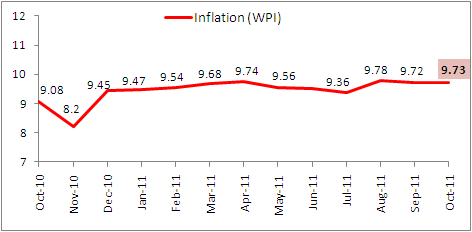
(Source :Office of Economic Advisor, PersonalFN Research)
This is the eleventh consecutive month where headline inflation has remained sticky over the 9.0% mark, which in turn is likely to put pressure on the RBI to look for alternative policy stance to bring inflationary pressures under control. While the apex bank has already said that another rate hike at its next mid-quarterly policy review in early December is unlikely, inflation numbers of the ensuing months would pave the path for RBI.
We believe that the headline WPI inflation may cool down mellow in the next couple of months as the Government has rolled back the increase in petrol prices and also due to the consecutive policy rate hikes undertaken by the central bank. However while inflation at present still remains at elevated levels, to know what you as investors in equity, debt and gold should do, click here.
| | | | Weekly Facts |
| Close | Change | %Change | | BSE Sensex* | 16,371.51 | (821.3) | -4.78% | | Re/US$ | 51.00 | (0.8) | -1.63% | Gold /10g /10g | 28,965.00 | 200.0  | 0.70% | | Crude ($/barrel) | 111.08 | (1.1) | -1.02% | | FD Rates (1-Yr) | 7.25% - 9.40% | Weekly change as on November 17, 2011
*BSE Sensex as on November 18, 2011 | | | | This Week's Poll !!!
************
Do you invest in IPOs for listing gains? To Vote Now!
| |
In an interview with the Business Standard, James Stewart, KPMG’s Global Head (Infrastructure) shared his views on the present state of infrastructure in India, the pace of development of infrastructure in India and the funding problem for the infrastructure in India.
Mr. Stewart believes that the need and demand for infrastructure is well researched and understood. Thus, he says that the key focus should be integration in execution - between different infrastructure sectors themselves and institutions with differing jurisdictions of scope, function and geography. "The focus has to be on an empowered mechanism that integrates infrastructure development to expedite the delivery process but which retains checks and balances within to ensure accountability. The importance of integration lies in gaps that appear between different pieces of infrastructure. They adversely affect the availability of goods and services to the end user, affecting prices and by extension, inflation which, in turn, retards growth," he explained further.
According to Mr. Stewart, in the last decade selected states have strengthened their infrastructure. He says, "This is not merely a political outcome with leaders taking cognisance of development driving political success. Rather, it stems from the fact that leaders have realised that quality infrastructure is also necessary to increase competitiveness in attracting industry and, thus, investments to the state for greater prosperity." Thus, he thinks that there will be relatively greater action from the state and local level compared to central agencies in the coming few years.
Mr. Stewart feels that the volume of infrastructure investment is going to put severe pressure on the lending capacity of the banks, and there is likely to be a capacity gap; although India is not alone in this predicament. "Banks are not the natural long-term lenders for infrastructure. Their expertise is in understanding construction and development risk. But, once the project gets to the operational phase with less risky long-term cash flows, the natural lenders are the institutions who wish to buy long-term cash flows to match their long-term liabilities. Therefore India, like a lot of other countries, needs to find a way of bringing more institutional debt to the market. The proposal for an infrastructure debt fund is therefore an excellent initiative," he said.
| |
Yield:The income return on an investment. This refers to the interest or dividends received from a security and is usually expressed annually as a percentage based on the investment's cost, its current market value or its face value.
(Source: Investopedia) | | | QUOTE OF THE WEEK
"It’s not the hours you put in your work that count, it's work you put in the hours."
- Sam Ewing | | |