Indian Railway Finance Corporation Ltd. (IRFC), which was established in 1986, is a dedicated financing arm of the Ministry of Railways (MoR). Its sole objective is to raise money from the capital market to part finance the plan outlay of Indian Railways. The money so made available is used for acquisition of rolling stock assets and for meeting other developmental needs of the Indian Railways.
IRFC has announced the issue of ‘Tax Free IRFC Bonds’. The issue size of the bond is  1,000 crores with a green shoe option to retain oversubscription. The issue opens on November 15, 2010 and is available for application till December 3, 2010.
The other details as may be required by you are:
Tax Free IRFC Bonds
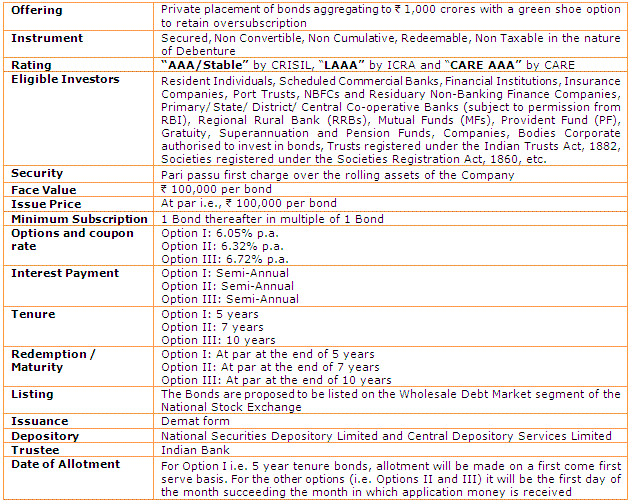
(Source: Offer Document of IRFC Bonds & PersonalFN Research)
Note:
- The maximum application amount under Option I is 20 crore.
- Interest on application money will be received at coupon rate (subject to the tax deduction at source, as applicable) from the date of credit of the application money in IRFC’s account till the day prior to the deemed date of allotment.
The tax free yield which one will enjoy at the time of maturity of these bonds is as under:

(Source: Offer Document of IRFC Bonds & PersonalFN Research)
Well, after reading the details of the bonds (as provided above), there may be still some more questions popping up, which are answered hereunder:
- What is the Tax Treatment of interest on these Bonds? Are these Bonds Tax Free?
Yes, the interests on these bonds are tax free.
- Can a minor apply to these bonds?
Yes, a minor can apply for these bonds, but only through a guardian.
- Can one apply in joint names?
Yes, one may apply in a joint name. However, the demat accounts will also be required to be held in joint name and the order of applicant shall be the same as appearing in the demat account.
- Who will get the interest in case of joint application?
In case of joint application, interest will be accounted to the first holder only.
- My demat account is in joint name, but I want to apply is a single name?
In case of a single application, demat account of the same single applicant would be necessary. Joint demat account would not do.
- If I’m an NRI can I invest in these bonds?
No.
- Is there a lock-in period while investing?
No.
- In whose favour the cheque is to be made?
Cheque has to be made in the favour of “Indian Railway Finance Corporation Ltd.”
So you may ask is it worth investing?
Strengths of IRFC
The stability of IRFC Ltd. continues to be strong due to the support received from its parent, the Government of India (GoI). Indian Railways (IR) constitutes a crucial part of India’s infrastructure and hence IRFC plays a strategic role in GoI’s infrastructure policy. It’s (IRFC) net interest margins and the interest rate risks and foreign exchange risks are taken care of due to GoI ownership. Moreover, IRFC’s liquidity is supported by its ability to receive advance lease rentals from IR, should it fall short of funds to service its debt.
IRFC’s profit after tax (PAT) for the year ended March 31, 2010 is 442.69 crore, while its Capital Adequacy Ratio (CAR) as on the same date stood at 152.38%.
OUR VIEW:
In our opinion the bond offering is stable, given the support from its parent, the GoI. But when analysed, the tax free yield at the end of the respective tenures for the options available isn’t very appealing. Moreover, the minimum amount (of 100,000 for each bond) which one has to shell out commands a big ticket size.
Hence we recommend investors to give a miss to this bond issue. In our opinion from a tax saving point of view one may invest in a “long-term infrastructure bond”, which offers you a tax benefit under section 80CCF, and where the post-tax yield is high, along with high safety.
Add Comments