| Weekly Facts |
| |
Close |
Change |
%Change |
| BSE Sensex |
17,730.24 |
113.6  |
0.64% |
| Re/US$ |
46.50 |
0.2  |
0.41% |
| Gold Rs/10g |
18,665.00 |
25.0 |
0.13% |
| Crude ($/barrel) |
74.78 |
2.2 |
2.91% |
| FD Rates (1-Yr) |
5.00%-6.50% |
Weekly change as on June 24, 2010

Impact
 The two-month long tussle between the two regulators - Securities and Exchange Board of India (SEBI) and Insurance Regulatory and Development Authority (IRDA), finally came to an end as the Government settled the tussle by issuing an ordinance, which ruled that Unit Linked Insurance Products (ULIPs) will be regulated by IRDA. The two-month long tussle between the two regulators - Securities and Exchange Board of India (SEBI) and Insurance Regulatory and Development Authority (IRDA), finally came to an end as the Government settled the tussle by issuing an ordinance, which ruled that Unit Linked Insurance Products (ULIPs) will be regulated by IRDA.
The Law Ministry issued an ordinance amending the RBI Act 1934, Insurance Act 1938, SEBI Act 1992 and Securities Contract Regulations Act 1956 thus clarifying that life insurance business will include any ULIP or scripts or any such instruments.
As per a senior IRDA official, the Finance Ministry has asked the IRDA to take the following steps, while ruling the matter in their favour:
-
Increase in life cover - Increase the life cover to 10 times of premium paid, as against the present practice of 5 times of premium paid
-
Minimum Life cover - Set the minimum life cover for ULIPs to Rs 1 lakh
-
Minimum guarantee - Offering in minimum guarantee at maturity, alike pension products
Reacting to this ruling, IRDA Chairman, Mr. J. Hari Narayan said, "We will revise the guidelines for ULIPs to make it attractive for investors. Insurers will also be given more time to redesign these products".
We think that although the ruling is in favour of IRDA, the capital market regulator - SEBI has been successful in making its point that ULIPs have a very low element of insurance cover. We also think that such regulations may also make ULIPs attractive for investors as it is aimed to encourage long-term savings and help policyholders build a nest egg to cater to their needs, as they grow old.
Inflation in double digits
Impact
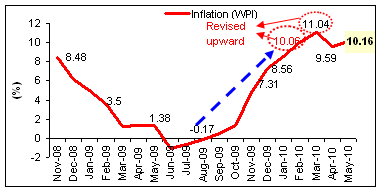
The broader price index as measured by the Wholesale Price Index (WPI) rose as temperatures dropped. WPI inflation for the month of May remained in doubled digits at 10.16%, after showing signs of cooling-off in the previous month (9.59% in April 2010). As per Government data, the jump in WPI inflation was on account of increase in prices across all segments.
WPI inflation numbers for February and March were also revised upwards to 10.06% and 11.04% respectively. Moreover, now there are also chances that April’s inflation figure of 9.59% would also be revised upwards.
The rise in inflation has also rung an alarm bell for the Reserve Bank of India to consider increasing policy rates. Mr. Kaushik Basu - Chief Economic Adviser to the Finance Ministry said, "Inflation is lower than March when it was 11.04% as per the revised figures. But it is in double digits and so is a matter of concern". Similarly, even Mr. Ashok Chawla - the Finance Secretary said, "It (high inflation) is always a matter of concern. Something more needs to be done by RBI".
We believe that RBI will certainly adopt the calibrated exit path by raising policy rates by 25 basis points at each step to normalise policy rates and make it more relevant to the current high economic growth and spiralling inflation. But in our opinion, the chances of a rise in the policy rate looks bleak before the first quarter review of monetary policy 2010-11 (scheduled for July 27, 2010) as worries on the Euro zone crisis still remain.
Sell insurance through "need analysis", says IRDA
Impact
 In order to ensure that prospective policy holders are advised on an appropriate insurance plan by their agent, the IRDA has emphasised on the requirement for a "need analysis", while selling insurance products. The IRDA has said it proposes to introduce a mandatory system where agents and brokers will need to prove the rationale behind selling a particular policy to their clients. In order to ensure that prospective policy holders are advised on an appropriate insurance plan by their agent, the IRDA has emphasised on the requirement for a "need analysis", while selling insurance products. The IRDA has said it proposes to introduce a mandatory system where agents and brokers will need to prove the rationale behind selling a particular policy to their clients.
Hence, now as per this "need analysis" requirement, the agent will have to advise on an insurance product, based on the financial profile of an individual by taking into account a host of factors such as age, annual income, financial situation and needs, investment objective, time horizon, risk appetite, liquidity needs, intended use of the policy’s benefits/returns, existing assets and insurance policies, tax status etc.
However, in order to arrive at a "need analysis", the agents would be required to collect important data and categorise it into 10 broad heads:
-
Details of individual
-
Details of family
-
Details of employment
-
Existing insurance coverage
-
Pensions
-
Current and projected income
-
Current and projected expenditure
-
Affordable contribution
-
Identified life requirements
-
Other financial particulars
Moreover, in order to monitor the "need analysis" system of selling insurance, the IRDA has said insurers will have to obtain and thereby maintain a record of a duly filled in need analysis document from their agents for every proposal they receive. In cases where the client refuses to co-operate in providing information for the analysis, it will also have to be recorded by the agent and counter checked and recorded by the insurer.
We believe this measure taken by IRDA, is in the long-term interest of the prospective policy holders as this may preclude mis-selling. However, in our opinion in order to adopt the right method, this also calls for the need for financial planning training for insurance agents.
In an interview with the Economic Times, India’s Chief Statistician, Dr. Pronob Sen shared his view on high food inflation, Finance Ministry’s forecast of 8.5% GDP growth for FY 2011 and the impact of the European crisis on India.
On high food inflation (16.90% for the week ended June 12, 2010), he is of the opinion that the situation is quite similar to the one prevalent a year ago. "We have had a period of high inflation, prices went up to a level and have stabilised at that particular level", he said. But nonetheless, he also believes that if the monsoons are good, it will actually help to cool prices but there can be some contradictory influences. He explained this by saying, “for instance, if today a farmer is expecting a good monsoon, he expects to have a good income in the future. He might actually start increasing his consumption in anticipation of a good harvest. Then, there will be no change in supply, but demand will increase. That pushes inflation a little bit more”. Dr. Sen also thinks that food inflation is getting more generalised and therefore expressed his worry on the same.
On the Finance Ministry’s forecast of 8.5% GDP growth for FY 2011, he is of the opinion that Index of Industrial Production (IIP) will taper to 8.0% in the coming months, and therefore a 8.5% GDP growth rate would be difficult but not impossible. He also believes that for such a GDP growth rate to take place, we require a supportive environment and presently we don’t know what will happen in the global economy.
On the impact of the European crisis on the Indian economy, he thinks that India is a much better placed to manage any problems, whenever and if they unfold. We won’t see the same kind of shocks as last year. He believes that even if there is a banking crisis globally, the trade credit will not be affected much. In his opinion, what will affect us is the slow down in international demand. “If international trade comes down, it’ll impact us, but the effect won’t be too large”, he said.
-
After showing two years of economic slowdown, the Indian economy is likely to grow by 9.2% this fiscal on account of the rebound in three key sectors - industrial, services and manufacturing, said the Centre for Monitoring Indian Economy (CMIE).
-
Warren Buffet’s Berkshire Hathaway is making a modest entry in the Indian insurance market by obtaining a corporate agency license. It plans to set up a wholly- owned subsidiary in India that will obtain a corporate agency license from IRDA to sell online auto insurance policies from Bajaj Allianz General Insurance. The subsidiary will invest close to Rs 50 crore to set up a support structure, which includes call centres.
-
The Finance Ministry is presently exploring options to raise personal income tax base exemption limit in the Direct Tax Code (DTC), in order to compensate investors for high inflation. "There is a case for increasing the income tax threshold," a finance ministry official said, adding that high prices were a source of worry for taxpayers. The proposal which is still in its initial stages, involves increasing the base exemption limit by upto Rs 40,000.
-
While addressing at the 6th Mutual Fund Summit 2010 organised by Confederation of Indian Industry (CII), Mr. C.B. Bhave - Chairman of SEBI criticised the mutual fund houses for their incentive structure and their short-term interests. He said, "the incentive structure drives away the investors, as what is good for the industry in the short-term would not be beneficial to the investors in the short-term".
ü Mutual fund houses should introduce new range of offerings in the market to attract investments
ü In order to make mutual funds more acceptable to retail investors, the industry should offer comprehensive life cycle planning, and not produce products alone
ü Exchange Traded Funds (ETFs) should be given a boost by bringing them into increased focus
ü Mutual fund houses need to invest in technology, in order to streamline their distribution network
-
-
Bombay Stock Exchange (BSE) will soon provide corporate information in a global standard format. The exchange has tied up with SWIFT (Society for Worldwide Interbank Financial Telecommunication) to provide ‘Corporate Actions to Custodians’ in the ISO 15022 format, a globally accepted standard for messaging for securities trading. The initiative makes BSE the first securities market infrastructure member of SWIFT in India.
-
In a move to help cancer patients, HDFC Mutual Fund filed an offer document with SEBI to launch a 3 year close-ended fixed income fund, in which investors will have the discretion to make donations to the Indian Cancer Society. Investors can select to donate 50% or 100% of the dividend they receive.
|
|
IN THIS ISSUE 
Think you know someone that will enjoy this email? Why not send it to a friend?
Pension Plan: A type of retirement plan, usually tax exempt, wherein an employer makes contributions toward a pool of funds set aside for an employee's future benefit. The pool of funds is then invested on the employee's behalf, allowing the employee to receive benefits upon retirement.
(Source: www.investopedia.com)
QUOTE OF THE WEEK
Quote: "You can never predict when that unknown torpedo will come out of the dark and smash the price of a stock”
- Ralph Seger.
{C}{C}
ATTENTION WOMEN!
************
We bring you something invaluable, interesting, exclusive...and FREE!

"Dear subscribers, we would like to inform you that, now all the updates by PersonalFN are also available on Twitter. You can get all the latest updates, about PersonalFN and Financial News Simplified (FNS), by simply following us on Twitter."

|