The Reserve Bank of India (RBI) in its third quarter mid-review of Monetary Policy 2010-11 kept its key policy rates unchanged despite the robust GDP (8.9% in Q2 of FY 2010-11) and IIP (10.8% in October 2010) numbers, as tight liquidity situation prevailed (since last couple of months) which was beyond the comfort levels of RBI.
Hence now the policy rates remain unchanged as under:
Repo rate at 6.25%; and
Reverse Repo rate at 5.25%
Thus maintaining the Liquidity Adjustment Facility (LAF) corridor between repo and reverse repo rate at 100 basis points.
The Cash Reserve Ratio (CRR) is also kept unchanged at 6.00%.
(PersonalFN expected policy rates remaining unchanged to the present levels (as mentioned above), and CRR too maintaining status quo)
However, the Statutory Liquidity Ratio (SLR) has been decided to be reduced from 25% to 24% with effect from December 18, 2010 taking into account the prevailing tight liquidity situation.
Bank rate on the other hand has been left unchanged at 6.00%.
Reason for such a policy stance :
The RBI is at present worried about the prevailing tight liquidity situation, which is above their comfort levels. The present tight liquidity situation was accentuated by:
- Relatively sluggish growth in bank deposits vis-à-vis credit growth
- Above-trend currency expansion
Moreover now as advance tax payments are scheduled this month liquidity situation is still expected to tighten further, and would remain tight till around March 2011.
Also the WPI inflation which was earlier hovering in the double-digit mark for the last 6 months, has now mellowed down to 7.48% in the month of November 2010 which also permitted RBI not to increase policy rate in its mid-quarter review of monetary policy.
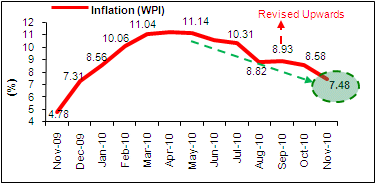
(Source: Office of Economic Advisor, PersonalFN)
Moreover, food inflation for the month of November 2010 had dropped to 9.41% from 14.13% in October 2010, and the expectation of it dropping further on account of good monsoon this year also permitted RBI not to increase policy rates.
Manufacturing inflation too had witnessed a marginal dip to 4.60% for November 2010 from 4.70% witnessed in the month of October 2010.
But not ruling out the risk that rising international commodity prices which may spill over to domestic inflation, the RBI’s projected inflation of 5.5% (by March 2011) has an upside risk.
(PersonalFN’s forecast for inflation range is 6.50% - 7.00% by fiscal year end)
We think that, core inflation will continue to exist as the Indian economy continues to trail the growth path.
Expected outcome from the policy stance:
The central bank’s stance of not increasing policy rates, but reducing the SLR is expected to:
- Ease primary liquidity situation in the country
- Bring down liquidity deficit in the system close to the comfort zone of the central bank
- Stabilise interest rates in the overnight inter-bank market
What does the policy stance mean and its impact?
The repo rate is the rate of interest charged by the central bank on borrowings by the commercial banks. Keeping them unchanged means, there will be no change in the cost of borrowings for commercial banks. Hence as a reaction to such a move, cost of borrowing for individuals and corporates may remain unchanged, as the commercial banks in the country may refrain from increasing lending rates.
Similarly, the interest rates on fixed deposits are also expected to remain unchanged to the current levels. At present 1 yr FDs (Fixed Deposits) are offering interest in the range of 6.50% - 7.75% p.a.
The reverse repo rate is the rate of interest, at which the banks park their surplus money with the central bank. Keeping them unchanged refers to commercial banks would continue to enjoy present interest rates for parking their surplus funds with RBI.
Statutory Liquid Ratio (SLR) is the amount that the commercial banks require to maintain in the form of cash, or gold or govt. approved securities before providing credit to the customers. A reduction in the same means banks can infuse more liquidity in the system, by providing credit.
GDP estimate:
RBI has kept its GDP (Gross Domestic Product) growth estimate unchanged at 8.5% for the fiscal year 2010-11 (as forecasted in Q1 review of monetary policy held on July 27, 2010), taking into account the following factors:
- Good monsoons and thus progress in the agriculture sector
- Robust economic growth as revealed by 8.9% GDP (for Q2 of FY 2010-11)
- Strong growth of 10.8% in IIP for October 2010
What should Debt fund investors do?
The central bank’s stance of not increasing policy rates but reducing the SLR by 100 basis points is a measure to improve liquidity in the system (which is tight at present). But such a move in our opinion is temporary to align credit growth rate and deposit growth rate. Hence going forward, we may experience policy rate hikes if inflation continues to be above the comfort zone of RBI, along with economic growth continuing. Earlier too, during the second quarter review of Monetary Policy 2010-11, the central bank had clearly said that, “Going forward, the growth-inflation outlook will dominate the policy response,” and has also added that "headline inflation... continues to be a cause of policy concern and priority.”
Hence, given that we are still in a rising interest rate scenario, as of now longer tenure debt mutual funds may not be an ideal investment for you; as bond prices and interest rates are inversely related to each other.
In the current scenario, you are recommended to stay away from long term income and government securities funds till RBI’s next (third) quarter monetary policy review meeting schedule for January 25, 2011.
Hence, if you have a short-term time horizon (of less than 3 months) you would be better off investing in liquid for the next 1 ½ month or liquid plus funds with a 3 to 6 months horizon; while if you have a medium term investment horizon (of over 6 months), you may allocate your investments to floating rate funds. Short term income funds should be held strictly with a 1 year time horizon.
You can also consider investing your money in Fixed Deposits (FDs). At present 1 yr FDs are offering interest in the range of 6.50% - 7.75% p.a.
Refrain from investing in long-term income funds and Government securities funds till the next monetary policy meeting, as we see policy rate hike from RBI, in its third quarter review of monetary policy (scheduled on January 25, 2010); which would then make long-term debt papers more attractive.
What to expect in the near future?
As liquidity easing measures are taken in this policy review meeting, yield on 1month CDs (which is at 8.95% as on December 15, 2010) and 3 month CDs (which is at 9.05% as on December 15, 2010), are expected to ease, thus making short-term debt papers look attractive.
We believe that RBI will continue adopting the calibrated exit path by increasing policy rates by 25 basis points if inflation climbs once again to uncomfortable zone, and provided the economic growth is intact.
Add Comments