  | | July 26, 2013 | | | | | | | Weekly Facts | | | Close | Change | %Change | | BSE Sensex* | 19,748.19 | 401.66 | -2.03% | | Re/US$ | 59.11 | 0.6 | 0.00%
| | Gold Rs/10g | 27,505.00 | 855.0 | 0.04% | | Crude ($/barrel) | 108.28 | (1.0) | -1.28% | | FD Rates (1-Yr) | 7.00% - 8.75% | Weekly change as on July 25, 2013
*BSE Sensex as on July 26, 2013 | |
Impact 
Nobody of us wants to make losses on investments; after all it's our hard earned money. But we must ask ourselves a question whether we take enough precaution before investing? As many of you may be aware, investment in debt / fixed income bearing instruments is done with the main motive of preservation of capital. In spite of knowing this and all other such theories, we endanger our money by falling prey to investment schemes promising high interest rates.
No, it's not about Ponzi schemes. Even some genuine companies offer a good premium of 300-350 basis points (3%-3.5%) over and above the rates offered by a public sector bank on a deposit of similar tenure. We are often reluctant to check the fundamentals of the company before investing in it. Companies with good brand values can also pass through tough times and at times even lesser known companies can also turn out to be excellent businesses. Now many of you might argue that how would a lay man know whether the company has a sound business model and bright prospects. True. But you should try to find out as to why the company is paying you a hefty premium to park your money with it.
PersonalFN is of the view that companies that offer noticeably high interest rates are those which need to raise funds instantaneously and have limited alternatives. You would be surprised to know that some well-known companies that have a good name in the market are being forced to offer high interest rates.
And don't make a mistake of gauging company's health based only on the state of the sector it belongs to. Pharmaceutical is often considered a recession proof sector but don't make a mistake of blindly committing your money to companies belonging to pharma. There have been instances in the past where companies have struggled to service debt.
Take the example of Pleathico Pharma which collected money from public in 2011 and was offering 11% interest rate for the duration of 1 year. The company had problems servicing its foreign debt and had to opt for debt restructuring. Ankur Drugs and Pharma is another company which raised money by paying as high as 12.50% under interest payout option and 13.10% under cumulative option with quarterly compounding. The company faced severe cash crunch so much so that the management had to issue a circular stating that they are delaying interest payment for several reasons which also included back-log of fixed deposit maturity payments. Suzlon, a leading wind turbine supplier, had terrible issues with interest payments and loan repayments, although it is unknown to PersonalFN whether it collected fixed deposits from public.
Birla Power Solutions is one more company that associates itself with a reputed group has also faced difficulties in servicing debt.
Jaiprakash Associates, one of the biggest corporate houses in India has relentlessly raised money to finance its massive expansion plans. However, the debt-pile has swollen to approximately Rs 46,000 crore which is about 4.4 times of its equity. While outlay towards payment of interest has been rising; growth has remained tepid.
PersonalFN believes that no company would pay higher interest unless there's some soft spot. The example of companies cited above are just to make you aware of how things can go wrong with apparently sound businesses. There can be tens of such instances. None of the aforesaid may have delayed or defaulted payments intentionally but investors have suffered anyway. As an investor, you should be watchful always. Mind you, fixed deposits are mainly unsecured in nature.
|
Impact 
RBI has been taking markets by surprise quite often nowadays. In a bid to arrest free fall of rupee, RBI tightened liquidity in the banking system by hiking short-term rates on July 15, 2013. The central bank increased the Marginal Standing Facility (MSF) and Bank Rate by 200 basis points (2%) pegging them at 10.25% each. It also had placed limit of Rs 75,000 crore on borrowing by banks under Liquidity Adjustment Facility Window (LAF). It was further decided that individual banks would be allocated funds in proportion to their bids subject to the thresholds limit. Banks meet their liquidity requirement by borrowing through various routes such as LAF and MSF. Seemingly rupee didn't raise upto the expectation of RBI. Rupee gained just about 1.5% since RBI introduced first round of measures on July 15, 2013.
This time RBI has fired another salvo and put an individual borrowing limit for banks borrowing under LAF window. Now banks can borrow only upto 0.5% of their Net Demand and Time Liabilities (NDTL). What's more, banks have also been asked to maintain Cash Reserve Ratio (CRR) of 99% (of 4% i.e. about 3.96%) on daily basis as against the minimum requirement of 70% (2.8%) which is currently in place. It is noteworthy that CRR requirement of average 4% on fortnightly basis remains unchanged. The only difference has been that now there's no room for fluctuation within a reporting fortnight.
The new round of changes has resulted in drain of liquidity from the system which has eventually pushed yields up and bond prices down.
| | Category Average Returns (absolute %) | | Category | 1 Day | July 15, 2013
To
July 24, 13 | 1 Year | | Long Term Income Funds | -0.6% | -2.6% | 7.1% | | Short Term Income Funds | -0.4% | -1.5% | 7.4% | | Short Term Floating Rate Funds | -0.1% | -0.4% | 8.0% | | Long Term Floating Funds | -0.2% | -0.9% | 7.0% | | Short Term Gilt Funds | -0.5% | -1.6% | 6.7% | | Long term Gilt Funds | -0.9% | -3.7% | 7.0% | | Liquid and Liquid Plus | -0.1% | -0.3% | 7.8% | (Data As on July 24, 2013)
(Source: ACE MF, PersonalFN Research)
All categories of debt funds have suffered without any exception. Long term gilt funds and long term income funds have suffered maximum losses since RBI shocked markets. Owing to rise in short term yields and overnight lending rates, even liquid and liquid funds suffered losses.
PersonalFN is of the view that, shorter end of the yield curve looks attractive at the moment and you shouldn't hold more than 20% of your debt portfolio in longer tenure funds. In case you have a high risk appetite and time horizon of 2 years and above, current market conditions offer a good entry point in longer tenure funds.
---------------------- Introducing PersonalFN's Guide to Investing in Gold --------------------- Many of us buy gold with an emotional touch. And why not, the glitter which it presents and the feeling of content it gives are truly worth it.
PersonalFN has Just Released a Guide to Investment in Gold, which reveals the smart way of investing in gold.
Download Your FREE Copy Here!
|
Impact
Cracking Rupee has become an every-day story these days and ill effects of currency depreciation are being felt even in common man's life now. Fall in rupee value has done more bad than good. Exports have not benefited much for variety of reasons including slowdown in European economies. Industries that directly depend on imports are the ones that have come in the firing line. Moreover, there are industries which may not have otherwise been affected directly with the fall in rupee have also taken a hit due to macro-economic changes rupee depreciation has brought in.
Some of them are important sectors and have fallen out of favour with investors. In this article we analyse, what has changed for them and would also discuss the outlook. Let's first look at who all are affected...
On a Slide?
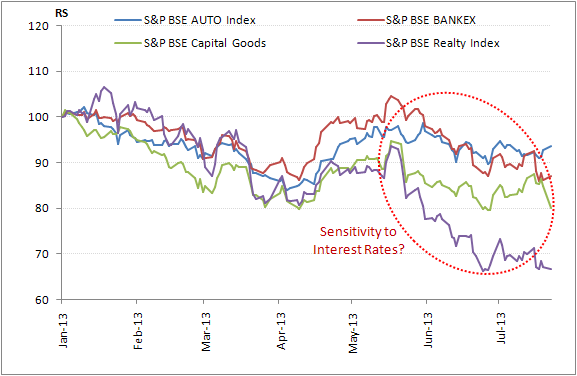
(Data as on July 22, 2013)
(Source: ACE MF, PersonalFN Research)
From the start of this year, widely tracked diversified largecap index, S&P BSE Sensex has given about 3% returns on absolute basis whereas Auto, Capital Goods, Banking and Real Estate companies have lost sharply.
What has changed for them?
Although dynamics driving growth in each of aforesaid sectors are different from one another; they have one thing common in them. All are sensitive to movement of interest rates, although to greater or lesser degrees.
To read more about this news and the view of PersonalFN over it, please click here.
|
Impact
Recently in one of the pink papers, country head of a leading international bank having operations in India as well, said NRI bond issue may be become imminent soon to contain the free-fall in the India rupee that has already impacted the Indian economy.
The rupee, as many of you may be aware, has depreciated over 8.5% against the U.S. dollar since the beginning of the current fiscal year. On July 8, 2013 it hit a lifetime low of Rs 61.21 against the U.S. dollar forcing the Reserve Bank of India (RBI) to step in and resort to unconventional measures to contain the slide in the rupee. Last week, the RBI increased short-term rates and adopted measures to contract liquidity in the system.
It is noteworthy that the weakness in the Indian rupee remains a threat to the country's Current Account Deficit (CAD), which in the last fiscal year touched a record high of 4.5% (at U.S. $87.8 billion) - much over the central bank's comfort level of 2.5% of GDP. While at present, measures to curb gold imports by India has paid the desired results, oil - which is another major import item for India - poses to be risk to India's CAD, since oil prices have once again ascended now after remaining quite docile earlier.
To read more about this news and the view of PersonalFN over it, please click here.
|
- Those who have not applied for 'Aadhar' may soon not be able to swipe their debit / credit cards while shopping. Unique Identification Authority of India (UIDAI) is expected to map 'Aadhar' numbers with your card numbers after receiving approval from RBI. Therefore, at the time of swiping your card you would be asked for biometric authentication.
PersonalFN believes that since biometric authentication would be done at the time of paying by cards, chances of frauds and shopping with counterfeited cards would substantially reduce. This is a step forward to addressing security concerns while using plastic money.
|
Demand Liabilities of Banks: A Demand Liabilities of a bank are liabilities which are payable on demand. These include current deposits, demand liabilities portion of savings bank deposits, margins held against letters of credit/guarantees, balances in overdue fixed deposits, cash certificates and cumulative/recurring deposits, outstanding Telegraphic Transfers (TTs), Mail Transfers (MTs), Demand Drafts (DDs), unclaimed deposits, credit balances in the Cash Credit account and deposits held as security for advances which are payable on demand. Money at Call and Short Notice from outside the Banking System should be shown against liability to others.
Source: Investopedia
|
Quote : "If you have trouble imagining a 20% loss in the stock market, you shouldn't be in stocks." - John Bogle
|
| |
| © Quantum Information Services Pvt. Ltd. All rights reserved.
Any act of copying, reproducing or distributing this newsletter whether wholly or in part, for any purpose without the permission of PersonalFN is strictly prohibited and shall be deemed to be copyright infringement.
Disclaimer: Quantum Information Services Pvt. Limited (PersonalFN) is not providing any investment advice through this service and, does not constitute or is not intended to constitute an offer to buy or sell, or a solicitation to an offer to buy or sell financial products, units or securities. All content and information is provided on an 'As Is' basis by PersonalFN. Information herein is believed to be reliable but PersonalFN does not warrant its completeness or accuracy and expressly disclaims all warranties and conditions of any kind, whether express or implied. PersonalFN and its subsidiaries / affiliates / sponsors or employees, personnel, directors will not be responsible for any direct / indirect loss or liability incurred by the user as a consequence of him or any other person on his behalf taking any investment decisions based on the contents and information provided herein. This is not a specific advisory service to meet the requirements of a specific client. Use of this information is at the user's own risk. The user must make his own investment decisions based on his specific investment objective and financial position and using such independent advisors as he believes necessary. All intellectual property rights emerging from this newsletter are and shall remain with PersonalFN. This is for your personal use and you shall not resell, copy, or redistribute this newsletter or any part of it, or use it for any commercial purpose. The performance data quoted represents past performance and does not guarantee future results. As a condition to accessing PersonalFN's content and website, you agree to our Terms and Conditions of Use, available here. |