  | | September 20, 2013 | | | | | | | Weekly Facts | | | Close | Change | %Change | | BSE Sensex* | 20,263.71 | 531.0 | 2.69% | | Re/US$ | 61.78 | 1.8 | 2.77% | | Gold Rs/10g | 30,280.00 | 65.0 | 0.22% | | Crude ($/barrel) | 111.59 | 0.3 | 0.22% | | FD Rates (1-Yr) | 8.25% - 9.00% | Weekly change as on September 19, 2013
*BSE Sensex as on September 20, 2013 | |
Impact 
If you have earned poor returns on your mutual fund investments over last 5 years, you wouldn't find yourself alone. Like you, many investors are unhappy with performance of mutual funds they have invested their hard earned monies in. Equity markets have been range-bound and people who had invested for the first time in mutual funds 5-6 years back are losing hope. As a reason, not only it has become difficult for fund houses to garner new business but has also become difficult to retain existing investors. Mutual fund industry has seen a lot of changes over last few years. The most impactful decision was to ban entry loads.
Prior to August 2009, about 2.50% of your investment amount was deducted as entry load and distributors were compensated using some portion of this money. Moreover, mutual fund houses paid exorbitantly high commissions to promote their New Fund Offers (NFOs). Entry loads were banned for a reason that they were misused. Distributors promoted fund without gauging the risk appetite of investors. Distributors encouraged investors to churn portfolio frequently as they were eyeing commissions on fresh investments.
But recently, while speaking to one of the leading daily newspapers, Mr U.K. Sinha, Chairman of SEBI (Securities and Exchange Board of India) didn't deny the possibility of bringing back the entry loads again, when asked about such possibility.
If banning entry loads was a decision taken keeping investors' interest in mind; rollback may help mutual fund houses which are struggling to manage their business. But would this move benefit investors?
PersonalFN believes allowing mutual funds to charge entry loads would be a regressive move for investors. Although there is no clarity as far as re-introduction of entry loads is concerned; such possibilities can't be denied looking at the poor state of mutual fund industry. PersonalFN is of the view that, you can still safeguard your interest by choosing your mutual fund advisor wisely and opting for direct plans. Direct plan helps you benefit from lower expense structure.
|
Impact
Rupee has been volatile but important steps are being taken to restore its value. Some initiatives taken by the finance ministry and RBI have not yielded desired results. However, among those which have proven to be effective, one measure stands out. There could be a rare investment opportunity for NRIs to earn excellent returns without carrying a currency risk.
Here's how
Foreign banks are planning to give upfront loans to NRIs for dollar deposits. Some banks are in a process of officially launching the special bank account. Interest rates on FCNR deposits have already been de-regulated. Now, banks are allowed to offer as high as 4% interest rates over and above the London Interbank Borrowing Rate (LIBOR). The aforesaid new account would be a variation to the FNCR account. The investors' contribution to the deposit would be only 10% and rest 90% would be contributed by the bank. In other words, banks would offer investors a leverage of 90%. RBI offered to swap amount raised under such schemes at a cheap rate of 3.5% which is almost half of the prevailing cost of hedge.
PersonalFN is of the view that it's a lucrative investment option for NRIs since net returns, after considering the leverage provided by the bank, are high. Moreover, the currency risk would be borne by the bank. It is noteworthy that, the scheme would be available to only few wealthy customers since the risk borne by the bank is high.
|
Money Simplified - Your Guide to Money & Mutual Funds
Watch our Money Simplified Videos released so far on:
⇒ Session 1 - Are You Saving OR Are You Investing?
⇒ Session 2 - Time Value of Money & When to Start Investing
Register and Watch Now! | |
Impact
Most of Indian households prefer bank fixed deposits over other asset classes. By nature, they are conservative. As per data published by RBI, about 56% of total household savings are invested in bank fixed deposits and nearly 15% go in provided and pension funds. Proportion of equity assets in total household savings has been just about 3%. It is often said that equity markets are unpredictable and thus the fixed deposit has been a preferred investment avenue. However, in investments, what should really matter is real rate of return. Real rate of return is nothing but inflation adjusted rate of return.
PersonalFN believes that instead of focusing only on nominal rate of return, i.e. interest rates offered by banks or the gross returns generated by a diversified mutual fund; you should always concentrate on tax-adjusted real rate of returns.
Unpredictability of inflation
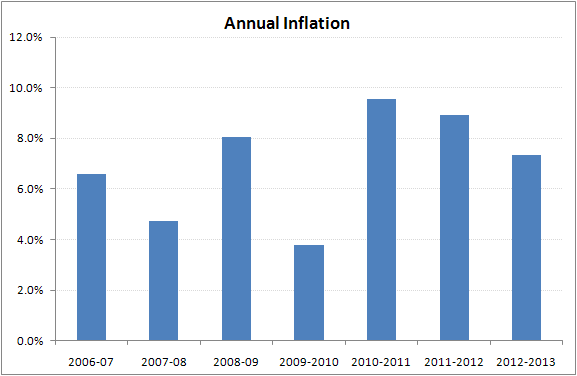
(Source: Ministry of Statistics and Programme Implementation)
As depicted in the chart above, inflation was low in 2007-08 and 2009-10. These were the years when investors had earned positive risk adjusted returns. Equity assets had done well in fiscals 2006-07, 2007-08 and 2009-2010. Due to relatively low inflation and higher nominal returns; real rate of returns was very high in equity assets. On the contrary, in 2008-09, 2010-11 and 2011-12 when inflation was high and nominal returns generated by equity assets were low or negative; fixed income instruments had done better in terms of generating higher risk-adjusted real rate of returns. Although inflation has started dipping in the current fiscal; there is still a huge upside risk due to depreciating rupee.
To read more about this news and the view of PersonalFN over it, please click here.
|
Impact
The mutual fund industry as many of you may be aware is undergoing turbulent times. Downbeat macroeconomic variables along with global economic headwinds, has brought in rampant volatility in the Indian capital markets, which in turn has resulted in low investor confidence. The mutual fund industry has been facing consistent equity folio closures in the past few months which is been a cause of concern for the Securities and Exchange Board of India (SEBI) as well.
But amid such a scenario, mutual fund houses are doing all they can to attract investors, especially the retail ones. Some time ago, IDFC Mutual Fund (the 8th largest fund house with asset of about Rs 39,000 crore as on June 30, 2013) introduced a new feature / benefit for its two schemes - IDFC Classic Equity Fund (a multi cap fund) and IDFC Sterling Equity Fund (a small cap fund), where if one invests in these schemes he /she would be entitled to a discount on various medical services. In order to provide such a benefit, IDFC Mutual Fund has tied up with Indian Health Organisation Ltd (IHO) - a leading health insurance organisation founded in 1853, which is a part of Aetna Inc. United States and is serving more than 35 million customers across the world. The main activity of IHO is to build a network of doctors, medical practitioners and hospitals.
To read more about this news and the view of PersonalFN over it, please click here.
|
- With an aim of protecting interest of minority shareholders, SEBI is planning to ask companies to give exit option to investors of public issues. It has been frequently observed that companies misuse proceeds of Initial Public Offers (IPOs) by diverting them to meet objectives which are not stated in the prospectus. Most often, majority shareholders ratify modifications in the prospectus at a later stage but minority shareholders remain unheard. To plug this loophole, SEBI is planning to give investors a right to exit in such cases. The market regulator has retained with itself the power of deciding the exit price for such investors.
PersonalFN is of the view that, this initiative may protect interest of minority shareholders but how the exit price will be decided holds the key. Merely providing an exit option may not help. What investors would want to see is exit option at fair price.
|
Real Rate of Return: : "It is the "annual percentage return realized on an investment, which is adjusted for changes in prices due to inflation or other external effects. This method expresses the nominal rate of return in real terms, which keeps the purchasing power of a given level of capital constant over time."
(Source: Investopedia)
|
Quote : "In the short run, the market is a voting machine, but in the long run it is a weighing machine." - Benjamin Graham
|
| |
| © Quantum Information Services Pvt. Ltd. All rights reserved.
Any act of copying, reproducing or distributing this newsletter whether wholly or in part, for any purpose without the permission of PersonalFN is strictly prohibited and shall be deemed to be copyright infringement.
Disclaimer: Quantum Information Services Pvt. Limited (PersonalFN) is not providing any investment advice through this service and, does not constitute or is not intended to constitute an offer to buy or sell, or a solicitation to an offer to buy or sell financial products, units or securities. All content and information is provided on an 'As Is' basis by PersonalFN. Information herein is believed to be reliable but PersonalFN does not warrant its completeness or accuracy and expressly disclaims all warranties and conditions of any kind, whether express or implied. PersonalFN and its subsidiaries / affiliates / sponsors or employees, personnel, directors will not be responsible for any direct / indirect loss or liability incurred by the user as a consequence of him or any other person on his behalf taking any investment decisions based on the contents and information provided herein. This is not a specific advisory service to meet the requirements of a specific client. Use of this information is at the user's own risk. The user must make his own investment decisions based on his specific investment objective and financial position and using such independent advisors as he believes necessary. All intellectual property rights emerging from this newsletter are and shall remain with PersonalFN. This is for your personal use and you shall not resell, copy, or redistribute this newsletter or any part of it, or use it for any commercial purpose. The performance data quoted represents past performance and does not guarantee future results. As a condition to accessing PersonalFN's content and website, you agree to our Terms and Conditions of Use, available here. |