
Impact 
After rising in May 2014 to 6.01%, the Wholesale Price Index (WPI) inflation declined to 5.43% in June 2014 However, the data for April was revised upward to 5.55% from 5.20% posted in the quick estimates.
WPI Inflation declines
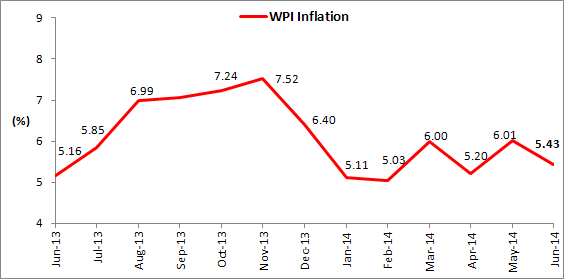
Data as on June 2014
(Source: Office of the Economic Advisor, PersonalFN Research)
Fall in inflation in June 2014 was mainly on account of:
Food inflation:
The data here revealed that food articles (which have a weightage of 14.34% in WPI) fell to 8.14% in June 2014 as compared to 9.50% in the previous month. Inflation in protein based items such as egg, meat and fish witnessed a decline to 10.27% in June 2014 from 12.47% in the previous month.
However, the prices of fruits witnessed an increase, with inflation thereto coming in at 21.40% for June 2014 vs. 19.40% in the previous month.
Vegetables prices have shown some relief for the common man as the inflation therein fell from -0.97% in May 2014 to -5.89% in June 2014. Inflation in onions has fallen to -10.70% in June 2014 from -2.83% in the previous month. Nevertheless, inflation in potatoes has risen from 31.44% in May 2014 to 42.52% in June 2014.
Fuel & Power inflation:
Fuel and power inflation (which has weightage of 14.91% in WPI), fell to 9.04% in June 2014 from 10.53% reported in the previous month. High Speed Diesel attributed to this constituent of inflation to report a decline. Inflation in Petrol too declined to 9.02% in June 2014 from 12.28% in the previous month.
Manufacturing inflation:
Inflation in manufacturing growth has increased very mildly due to the lull in industrial activity. The data came in at 3.61% in June 2014 up from 3.55% reported in the previous month. Although the rise is not very substantial, considering the weight of manufacturing inflation in the WPI (64.97%), the impact has been felt.
PersonalFN's View on inflation:
Although the WPI for June 2014 has mellowed down to 5.43%, the risk to inflation, especially on food prices, is heightened because of the official forecast of a below normal monsoon from the Indian Meteorological Department (IMD) due to 60-70% chances of an El-Nino phenomenon. As far as fuel and power inflation is concerned, although the inflation might have subsided in June 2014, the Government has recently allowed a hike in petrol and diesel prices which will infuse further risk to food inflation as diesel is essentially a transport fuel used in carrying agriculture produce.
So, would RBI cut rates in the next monetary policy review?
RBI has adopted inflation-targeting approach. By January 2015, retail inflation target has been set at 8.0% and 6.0% by January 2016. While the guidance to the 2nd bi-monthly monetary policy, has as dovish tone as the central bank said that if disinflation, adjusting for base effects, is faster than currently anticipated, it will provide headroom for an easing of the policy stance and it may set the downward path for interest rates if inflation glides as projected by RBI. In our opinion, the RBI is unlikely to reduce policy rates soon.
The RBI would be watchful to several factors as they pan out and their implication on inflation and the economy. You see, with Brent crude oil prices are on a rise on account of sectarian tension in Iraq, the rise is not only from food inflation (due to a sub-normal monsoon on account of an El-Nino phenomenon), but also from fuel prices. It is noteworthy since crude oil comprises a dominant portion in India's import list, it would have implications on trade deficit, Current Account Deficit, Indian rupee and even fiscal deficit.
So far on inflation and growth, the RBI and the Government seem to be on the same page and are reciting in chorus; which is good. It is noteworthy that the BJP led NDA in its top agenda has also mentioned about curbing unacceptably high inflation.
Impact on equity markets...
The markets have not moved much with the fall in the WPI Inflation. There is a wave of optimism in India at present. Stock markets are rising on the hope that Mr Modi-led NDA Government will revive the sagging Indian economic growth. However, as S&P BSE Sensex has hit the silver jubilee mark of 25,000 points, valuations have started ringing the warning bell. There is doubt afloat on whether this rally will sustain for too long. Moreover, the escalating sectarian tensions in the Iraq and its impact on crude oil prices may cause Indian equities markets to be a little slippery, for the reasons cited above.
Impact on debt markets...
India still struggles on the fiscal deficit front. Moreover, inflation remains sticky. Continuous issuance of long maturity debt may keep yields high, since yields on Indian sovereign debt is a function of supply of Indian debt, Sovereign rating of India and yields on Government debt of other nations, especially that of the U.S.
It has been seen that, UPA Government fell short of achieving revenue targets especially due to shortfall in tax receipts. On this backdrop the Mr Modi-led NDA Government would look at revising tax laws and implementing Direct Tax Code (DTC) and Goods and Services Tax (GST). Weaker industrial performance puts pressure on achieving aggressive revenue targets.
On the external front, containing Current Account Deficits (CAD) and enhancing forex kitty remain top priorities. Performance of the new Government on this front would have an impact on the Indian debt markets as well.
PersonalFN is of the view that, till anything changes on these fronts, it is unlikely that debt markets would be affected in a significant manner. They might just stay responsive to demand-supply dynamics. Having said this, any bad news on the inflation front as well as on fiscal deficit front, may negatively affect Indian debt markets.
Add Comments