
Impact 
The Wholesale Price Index (WPI) inflation for July 2014 declined to 5.19%; it being the second successive month of ease in prices which took the data for July 2014 to a 5-month low. However, the data for May 2014 was revised upward to 6.18% from 6.01% posted in the quick estimates.
WPI Inflation mellowed down yet again!
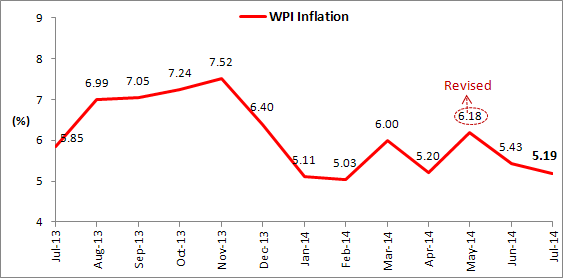
Data as on July 2014
(Source: Office of the Economic Advisor, PersonalFN Research)
The drop in WPI inflation in July 2014 was mainly on account of:
Fuel & Power inflation:
Fuel and power inflation (which has weightage of 14.91% in WPI) eased substantially in July 2014 to 7.40% from 9.04% reported in the previous month. The decline in prices of petrol attributed this constituent of inflation ease, since the inflation in petrol fell to 5.90% in July, from 9.02% in the month prior. Likewise, softening in price of High Speed Diesel and LPG also aided fuel & power inflation to ease.
Non-Food inflation:
The marginal decrease in prices of non-food articles (which have a weightage of 4.26% in WPI) to 3.32% in July 2014 % from 3.49% in the month prior, also helped WPI inflation for July 2014 decline.
However stickiness was seen in food inflation and manufacturing inflation.
Food inflation:
Food inflation (which has weightage of 14.34% in WPI) rose to 8.43% in July 2014 after mellowing down to 8.14% in the month prior. The increase was led by rise in prices of vegetables and fruits. Amongst vegetables, inflation in kitchen staples such as potatoes increased to 46.41% in July 2014 vs. 42.52% in June 2014...and a steep ascending moved has been seen over last 6 months. Inflation in onions which had fallen to -10.70% in June 2014 also rose to -8.13% in July 2014. Likewise, prices of fruits witnessed an increase with inflation thereto coming in at 31.71% for July 2014 vs. 21.40% in the previous month.
However for those with a protein rich diet consisting of eggs, meat and fish it was a sigh of relief as the inflation in these items reduced rather sharply to 2.71% in July 2014 from 10.27% in the previous month.
Manufacturing inflation:
Inflation in manufacturing activity (which has a weightage of 64.97% in WPI) increased very mildly as industrial activity depicted signs of breaking shackles. The data hereto reported an increase to 3.67% in July 2014 after having mellowed to 3.61% in the previous month.
PersonalFN’s View on inflation:
Going forward, inflation in fuel & power inflation is likely to descend aided by slithering international oil prices despite the geopolitical tensions. In fact, recognising this trend in global oil prices, the Government announced reduction in price of petrol by Rs 1.89-2.38 per litre from August 15; it being second reduction in rates in the month and the steepest in 11 months. While diesel prices are increasing by 50 paise per litre (as a result of Government’s decision to eliminate subsidy in stages through monthly increases in prices), at present it is rather benign on inflation in diesel.
As far as food inflation is concerned, the concern yet remains over the progress of the monsoon. Out of 36 meteorological sub-divisions, the rainfall has been excess over 7, normal over 6, deficient over 16 and scanty over 7 sub-divisions. In area-wise distribution, 35% area of the country received excess/normal rainfall, 48% received deficient rainfall and remaining 17% area received scanty rainfall. The Government is already indicating that rainfall across the country will be ‘deficient’ compared with its earlier prediction of ‘below normal’ precipitation for the season. This as a result may impact agriculture output and thus trigger concerns on inflation front. Therefore for the month of August, it likely that food inflation may stay elevated. But as the winter crop arrives and prices at mandis start softening (aided by the measures taken by the Government as well in the last couple of months), a positive impact may be felt from September-October onwards. Amid this, a favourable impact of high base effect may also come to rescue.
You see, retail inflation as measured by the movement of Consumer Price Index (CPI) has risen to 7.96% in July 2014 vis-à-vis 7.46% in the month prior, as higher food inflation precipitated through prices of cereals, vegetables and milk products showed its impact. Even now with deficiency in rainfall the risk accentuates for cereals and vegetables. But a reason for a wide divergence in retail and wholesale inflation is that seasonal exclusion of tomatoes in wholesale price index from April to July and food accounts for almost half of the consumer price index basket, against 14.34% in wholesale price basket.
So, would RBI cut rates in the next monetary policy review?
The Reserve Bank of India (RBI) has adopted inflation-targeting approach thus far as stickiness in inflation yet remains. The RBI is focusing on the CPI inflation data and has set in a target of 8.0% CPI inflation by January 2015 and 6.0% by January 2016. The RBI in its 3rd bi-monthly monetary policy statement for 2014-15 has cited that it will continue to monitor inflation closely as it remains committed to its disinflationary path. As retail inflation for July 2014 has inched-up from the month before, it is showing irregularities in disinflationary process and therefore it remains to be seen whether it can be sustained over the medium-term. The balance of risks around the medium-term inflation path, and especially the target of 6.0% by January 2016, are still to the upside, warranting a heightened state of policy preparedness to contain these risks if they materialise. Therefore the central bank will act as necessary to ensure sustained disinflation. Thus in this backdrop, it appears unlikely that RBI would reduce policy rates in its ensuing 4th bi-monthly monetary policy statement (scheduled on September 30, 2014) and anytime this calendar year, in the backdrop of the risk to inflation and from other macroeconomic variables.
Impact on equity markets...
The markets have breathe a sigh of relief and moved upward with the release of WPI inflation data for July 2014 after a see-saw movement depicted by Index of Industrial Production (IIP) in June 2014 (data released on August 12, 2014) and uptick in CPI inflation. The S&P BSE Sensex has hit a new all-time high after Prime Minister Mr Modi has vowed to fire up the bureaucracy to deliver results. But to us valuations have started ringing the warning bell as they seem overstretched. It is noteworthy that a mere hope rally may not sustain for too long. Earnings will have to justify valuations and the Indian equity market would take cognisance of domestic macroeconomic, global economic headwinds and geopolitical tensions.
Impact on debt markets...
In the first three months of the fiscal year, the Centre's fiscal deficit has already crossed the Budget Estimate (BE) of Rs 5.31 lakh crore for 2014-15. The deficit, gap between expenditure and receipts; was at Rs 2.98 lakh crore, i.e. 56.1% of BE in the first quarter of the fiscal year. It is noteworthy that at this time, last year, the deficit was 48.4% of the BE while the UPA Government was in power. Now although the Modi-led-NDA Government came to power after almost two months of the current financial year passed and one needs to see how revenue streams (such as disinvestments, tax collections and dividends) along with the expenditures tend to flow more evenly through second-half of the fiscal year; it may not be easy to walk the talk on managing fiscal deficit.
However the recent news of RBI having decided to transfer a surplus amounting to Rs 52,679 crore for the year ending June 30, 2014(which is 60% more than that transferred last year) to the Government may be of some help in managing the fiscal deficit target set at 4.1% of GDP for the current fiscal year ending March 2015. Such a move has already resulted in of 10-Year bonds soften. Yields at the longer end of the maturity curve are likely to soften a bit further, as RBI has reduced bond auction size very week (by Rs 2,000 crore) till September 2014 since the decision of transfer of surplus for the year ending June 30, 2014 was taken. The Government has also cut the borrowing programme for the first half of the financial year without making changes in the overall indicative borrowing during the financial year.
So, the Indian debt markets are not only keeping track of the inflation data but even the other macroeconomic variables while reacting on yields.
Add Comments