Impact 
 As an investor, you can now get instant access to your mutual fund investment through an ATM card. Recently in the week gone by, the country's second largest mutual fund house (in terms of average assets under management) - Reliance Mutual Fund introduced its "Reliance Any Time Money Card", thus offering its investors the facility to access their invested money, just as they would do with their savings bank account.
The ATM card will be available to investors of Reliance Mutual Fund designated schemes through their online account with the fund house. The card offers all the convenience of a debit card for investments made in Reliance mutual fund schemes, and can used to withdraw cash from any VISA authorized ATM or make payments at Point of Sale (PoS) outlets.
We believe that while innovation introduced by the fund house enables investors to withdraw money (from their investments made), excessive withdrawals or usage at PoS outlets may hamper the growth potential of their investments made and also encourage incorrect spending habits.
| Multibagger Stock Ideas
Claim this Free & Exclusive Guide Today. Act Now!
CLICK HERE to know more... | | |
Impact
 The Securities and Exchange Board of India (SEBI) plans to regulate analyst, thus ensuring that financial services firms strengthen barriers - referred to as "Chinese walls" between research and business units - mainly investments banking, who influence the recommendations of analyst.
It is noteworthy that in India while credit rating agencies offer analytical services, and portfolio managers provide advisory services and manage clients' assets, they are governed by SEBI; however analysts do not come under any comprehensive regulatory framework.
But now the proposed rule will require even brokers to clearly state the reporting lines and compensation structure of analysts to eliminate conflict of interest. Moreover, the capital market regulator also plans to regulate analysts' trading activities of the firms they cover. At present, analysts are required to disclose their holding in a client company and are not allowed to trade in the shares of those companies (which they are recommending) for 30 days from preparation of such a report.
We believe that if a plan to regulate analysts' is indeed implemented, the inherent conflict of interest may be removed - especially in case of investment banking firms. Moreover, research analyst would have the freedom to providing unbiased views on companies as they perform their duties, which in turn would be in the long-term interest of investors' who easily get influenced by the views given by analysts.
| |
Impact
The Wholesale Price Index (WPI) inflation for November 2011 mellowed to a 12 month low of 9.11%, thus taking a 62 basis points (bps) descending move from the data registered in the previous month. The fall in headline inflation mainly occurred as food inflation landed below the double-digit terrain to 8.54% in November 2011 (from 11.06% registered in the previous month).
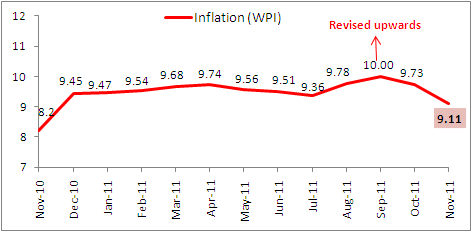
(Source :Office of Economic Advisor, PersonalFN Research)
But interestingly if we assess the stubbornness in WPI inflation is still evident as it continues to be over the 9.00% mark for consecutive 12 months, and is still above the 6.00% - 7.00% comfort range of the Reserve Bank of India (RBI).
Going forward while many economists expect WPI inflation for December 2011 to be around 8.00%, we think that the present fall in the Indian rupee, would dampen those expectations. It is noteworthy that that the crash of the Indian rupee to a life time low of 54.00 per U.S. dollar is leaving a lasting scar on the Indian economy as well as the corporates. Citizens too are already feeling the pinch of high prices, and have little hope of relief as it would now elevate the chances of "imported inflation". The Indian rupee has been the worst performing currency in Asia with a fall of -21% since August 2011. Currencies of other emerging economies are also falling, but the depreciation of the Indian rupee has been rather steep due to contraction in the industrial output and battered Government finances on account of turbulence in the currency markets steered by Euro zone debt crisis.
But assessing the fact we have had above normal monsoon we expect food inflation to mellow, which may thus aid in pulling down WPI inflation as well. However, fuel prices should remain under check. If things pan out positively, we expect WPI inflation to be in the range of 7.00% - 7.50% by March 2012.
| | | | Weekly Facts |
| Close | Change | %Change | | BSE Sensex* | 15,491.35 | (722.1) | -4.45% | | Re/US$ | 53.65 | 1.9  | 3.65% | Gold /10g /10g | 27,685.00 | (1,450.0) | -4.98% | | Crude ($/barrel) | 104.57 | (4.7) | -4.27% | | FD Rates (1-Yr) | 7.25% - 9.40% | Weekly change as on December 15, 2011
*BSE Sensex as on December 16, 2011 | | | | This Week's Poll !!!
************
Would you withdraw your MF investments through an ATM card? To Vote Now!
| |
In an interview with the Economic Times, Mr. Kaushik Basu - Chief Economic Advisor to the Finance Ministry shared his views on new economic growth forecast being cut to 7.50%, how the Indian rupee would perform in the coming months and whether "policy paralysis" prompted by pause in Foreign Direct Investment (FDI) will affect business sentiment, investments and therefore growth.
On the economic growth forecast being cut to 7.50%, Mr. Basu expressed that it has been done so because of both global and domestic factors. However he's of the view that beyond this forecast point, the big downside risk comes from Europe. "If Europe tanks, for instance with the periphery falling off, this will infect other nations. Italy will be in deep trouble. That in turn will adversely impact French banks, which have a huge exposure to Italy; USA also has large secondary exposure to Italy and will feel some of the heat. As this spreads, it will quickly affect our economy and the downside scenario of 7.25% could occur. But if Europe shows signs of stabilization, I expect the world growth will stabilize - the US employment has shown some improvement of late, and 7.5% or even higher growth is possible for us.", he said.
Speaking about how the Indian rupee would perform going forward, he expressed that we had higher inflation than all industrialised countries over the last nearly two years and thus the rupee has been losing relative value. According to him the rapid depreciation in the Indian rupee between August and October was quite worrisome, and if there is a sharp movement now, the RBI has said it will act to stop volatility; which he believes would be the right approach.
On the "policy paralysis" prompted by pause in FDI he's of the view that it is not going to cause anything anew. "There has been a mood of despondency in India but the Indian economy has a way of performing well despite government. So I don't think these recent events are going to add anything to the mood and to the performance on the downside. But had we managed to undertake this reform it would have created a glow of optimism, which would have helped a lot. That additional boost we will, unfortunately, not get.", he said.
| |
Financial Asset: An asset that derives value because of a contractual claim. Stocks, bonds, bank deposits, and the like are all examples of financial assets.
(Source: Investopedia) | | | QUOTE OF THE WEEK
"Never invest in a business you cannot understand."
- Warren Buffet | | |