Impact 
 Once again treading on 'pro-policyholder' foot steps, the Insurance Regulatory and Development Authority (IRDA) has started monitoring claim settlements of both life and non-life insurance companies to detect unwarranted delays in payouts. Heavy penalties would be levied on insurance companies if found guilty, IRDA said. Once again treading on 'pro-policyholder' foot steps, the Insurance Regulatory and Development Authority (IRDA) has started monitoring claim settlements of both life and non-life insurance companies to detect unwarranted delays in payouts. Heavy penalties would be levied on insurance companies if found guilty, IRDA said.
As a part of its pro-policyholder campaign, IRDA had last year launched the integrated grievance management system wherein customers could register their complaints online and track its status.
The insurance regulator thus now would be classifying complaints into different categories to identify instances of violation/non-compliance by insurance companies so that regulatory action could be taken wherever required. Moreover it depicts to be a step beyond mere facilitation of complaint resolution.
In our opinion, if the above pro-investor measure is implemented by IRDA, policyholders will experience fast expedition of their insurance claims. Moreover, in cases where the claim is repudiated by the insurer, policyholders will obtain a substantial explanation (from the insurer) for the same, citing the reasons therein. This thus will also put an end to the mal-practices followed by insurance companies, where they reject claims on insufficient grounds.
But, policyholders' should keep in mind that they have an important role to play for their claims to get settled soon. It is very important to provide correct information to the insurance companies so that the underwriting is done appropriately. Remember any mis-leading information provided by you may become a reason for your claim to get repudiated. |
Multibagger Stock Ideas
Claim this Free & Exclusive Guide Today. Act Now!
CLICK HERE to know more...
|
|

Impact 
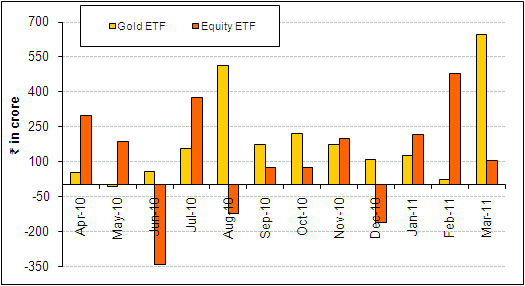
(Source : AMFI , PersonalFN Research)
Indian retail investors are displaying trends of betting big in Exchange Traded Funds (ETFs) as an investment avenue. The participation by and large have been in Equity ETFs as well as gold ETFs; but investors have exuded confidence more towards the precious yellow metal, by investing in Gold ETFs, as it remained a safe haven during times of economic and political uncertainty.
Compared to diversified equity mutual funds, ETFs was the only category which registered a four-fold increase in inflow of funds. Net inflows in the ETF segment were Rs 3,638 crore, as against a meagre Rs 784 crore in the previous financial year. The number of folios jumped from a little over 200,000 to 420,000. The funds thus mobilised were Rs 7,709 crore against Rs 3,535 crore earlier, up 118%.
Most of the ETFs are passively managed funds as they try and replicate their benchmarks to provide similar returns. Hence, the risks associated with this category are minimal as compared to diversified equity funds.
We believe the numbers displayed above are reflecting that investors who are conservative in their risk profile and investment approach are now investing in Exchange Traded Funds (ETFs). Also the low expense ratio (of 0.35% to 1.00%) seems to have enticed investors towards ETFs where they seek to achieve returns almost equivalent to the benchmark index.
However, in our opinion diversified equity mutual funds would be a better investment avenue as compared to Equity ETFs especially; because in India the benchmark index (of the ETF) tends to witness change quite often. Very often stocks in the respective index go in and out of the index, which is unhealthy for the performance of ETFs.
But gold ETFs on the other hand can be bought as they help you investors to take exposure to this ever shining precious metal at a low cost. Risks associated with GETFs too are minimal. Also, as an investor you keep yourself free from the worries of storing physical gold and at the same time be rest assured of the quality of gold invested in, as physical gold in which GETFs invests is of 99.999% purity. |
|
Impact
 The Pension Fund Regulatory and Development Authority (PFRDA) now want to regulate of all existing pension schemes from insurance companies after the PFRDA Bill, introduced in Lok Sabha is passed. The Pension Fund Regulatory and Development Authority (PFRDA) now want to regulate of all existing pension schemes from insurance companies after the PFRDA Bill, introduced in Lok Sabha is passed.
PFRDA claims that monitoring all retirement and pension savings products is their mandate. Moreover, the Direct Taxes Code (DTC) too, gives PFRDA the power to approve savings intermediaries eligible for tax sops and prescribe an investment pattern for pension funds.
Life insurers at present own pension schemes in their product portfolio, as they are permitted under Insurance Act, 1938. Moreover, they (pension schemes) contribute a major portion of the insurers' revenue, which also infuses reluctance for the Insurance Regulatory and Development Authority (IRDA) to part with its regulatory powers on pension schemes to PFRDA.
We believe that both PFRDA and IRDA should act in a very responsibly and mature way. Instead of indulging in a regulatory turf war against each other, regulators should mutually settle the matter and come up with solutions which are in the policyholders' interest.
Proving one's mettle over the other and winning more regulatory powers is unhealthy for the industry as a whole. One should overview things at which one is best. So, instead of getting into a tussle, the respective regulators should behave in a mature way which is also in the larger interest of the industry and policyholders. |
|
| Weekly Facts |
|
Close |
Change |
%Change |
| BSE Sensex* |
19,602.23 |
215.4  |
1.11% |
| Re/US$ |
44.33 |
0.2 |
0.40% |
| GoldRs /10g |
21,720.00 |
555.0 |
2.62% |
| Crude ($/barrel) |
121.57 |
(1.2) |
-0.98% |
| FD Rates (1-Yr) |
7.00% - 9.00% |
Weekly change as on April 20, 2011,
*BSE Sensex as on April 21, 2011,
|
|
In this issue
|
|
This Week's Poll !!!
************
Do you buy shares based on tips received via sms?
To Vote Now!
|
|
In an interview with DNA Money Mr. Santosh Kamath, Chief Investment Officer - Franklin Templeton Mutual Fund shared his views on investing in debt markets, inflation in India, liquidity management measures by RBI and debt fund categories to outperform in 2011-12.
Mr. Kamath believes that the basic investment principles which apply to fixed income investing are patience and discipline. Explaining further on successfully investing in debt markets, he said, "An investor is recommended to invest in them keeping the investment horizon in mind. We recommend investors to stick to the financial plan and not get perturbed by short-term fluctuations in rates. Additionally, for Indian retail investors, it is important to recognise the tax advantage factor while choosing debt instruments."
As far as inflation is concerned, Mr. Kamath thinks that though the inflation levels have peaked, it is expected to remain elevated compared to the last decade on the back of structural changes - rising income levels driving changes to consumption patterns - as well as rising international oil and commodity prices. According to him, the near-term inflation outlook depends on trends in global commodity prices and monsoon. However, he feels that the government needs to step up efforts to plug supply side gaps and infrastructure bottlenecks to provide stability over the medium-term.
Explaining the extension of the liquidity measures by RBI, Mr. Kamath said, "While systemic liquidity levels had recovered from the excessively tight situation witnessed in March quarter, liquidity could remain under pressure due to high credit offtake along with the ongoing government borrowings programme. Liquidity conditions are likely to be more dynamic (bi-directional) as the year progresses, in line with the RBI's monetary/liquidity stance."
According to Mr. Kamath, short-term debt funds focused on corporate debt and accrual are likely to perform well in the current macro-economic environment over the medium term. Explaining further he said that once the interest rate cycle turns, funds focusing on high accrual will benefit from coupon payments as well as capital gains. However, he remains cautions about the yields at the longer end of the curve due to oil prices and possible fiscal slippages. |
|
Insurance underwriter : A financial professional that evaluates the risks of insuring a particular person or asset and uses that information to set premium pricing for insurance policies. Insurance underwriters are employed by insurance companies to help price life insurance, health insurance, property/casualty insurance and homeowners insurance, among others.
(Source: Investopedia)
|
|
QUOTE OF THE WEEK
"Make it a point to do something every day that you don't want to do. This is the golden rule for acquiring the habit of doing your duty without pain."
- Mark Twain
|
|