| S&P BSE Sensex* |
Re/US $ |
Gold Rs/10g |
Crude
($/barrel) |
FD Rates (1-Yr) |
18,619.72
|100.3
0.54%
|
66.55
|1.9
-2.97%
|
33,265.00
| 1,890.0
6.02%
|
118.11
|7.0
6.30%
|
8.00% - 9.00%
|
Weekly change as on August 29, 2013
*BSE Sensex as on August 30, 2013
Impact 
As you may be aware, India's fascination for gold is largely responsible for its swelling Current Account Deficit (CAD). Huge current account deficit has put tremendous pressure on Indian rupee. Steps taken so far to curb gold imports include, import duty hike and imposition of restriction on sale of gold by banks. Now going one step ahead, government wants to divert domestic gold to refiners and cut gold imports even further. On experimental basis, the government is considering to direct commercial banks to buy gold from citizens.
India is believed to possess 31,000 tons of commercially available gold which is worth approximately Rs 1.4 trillion as per current market value. RBI may soon going to ask banks to buy gold in the form of jewellery, gold bars and coins by offering attractive rates.
PersonalFN believes that this would be the first step towards monetising gold. If the scheme gets good response, the government may consider launching gold deposit schemes and may even think of other avenues to collect gold against cash. Fall in gold imports may help India bridge the gap in CAD which in turn may prop up Indian currency. Moreover, gold prices may decline in international markets if India cuts back its gold imports substantially by channelising domestic gold to meet demand. PersonalFN is of the view that, you may benefit from such initiatives of gold monetisation; as gold which is idle in your safes may generate returns for you.
Should you buy Indian equities while FIIs are dumping?
Impact 
The Indian equity markets (i.e. the S&P BSE Sensex) thus far in the month of August 2013 (i.e. as on August 27, 2013), has encountered vehement turbulence and is down with a glary loss of -7.0%. Warnings from a few rating agencies for a downgrade on India, also sent shivers to the market. Fitch at present, while has maintained a stable outlook with 'BBB-' sovereign credit rating; it has said that it was getting more challenging for India to meet its fiscal deficit target in the current fiscal year ending March 2014 with revenues slowing and the rating agency could act if the Government fails to calm financial market tensions. The Food Security Bill recently passed in the Lok Sabha, has a support of Rs 1,30,000 crore (the largest in the world) and that subsidy in itself has an effect of putting a burden on country's fiscal deficit, albeit Finance Minister Mr Chidambaram is confident that the fiscal deficit would be contained at 4.8% of GDP.
S&P BSE Sensex vs. FII inflows
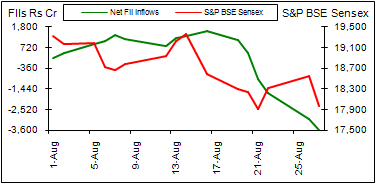
Data as on August 27, 2013
PersonalFN Research)
In the backdrop of the aforesaid macroeconomic variables in play, Foreign Institutional Investors (FIIs) continued to be net seller in the Indian equity markets to the tune of Rs 3,571 crore (as on August 27, 2013). Cumulatively in the June, July and August thus far, they have sold Indian equities net to tune of Rs 20,684 crore.
Apart from the aforementioned macroeconomic variables, FIIs seemed to be concerned about the following factors which are in play in the domestic economy:
Reform measures not translating very well (although the economy has been opened up with increase in Foreign Direct Investment (FDI) limit);
Lack of consensus on policies;
Deteriorating state of governance ;
Scam stories unveiling; and
Structural bottlenecks
While the Securities and Exchange Board of India (SEBI) brought in reforms (towards June-end) aimed at including creation of an umbrella class of investors that will do away with the separate category for FIIs and approving doing away with the current practice of FIIs and their sub-accounts requiring a prior direct registration to operate in Indian markets; it hasn't enthused them to exude confidence in Indian equities.
To read more about this news and the view of PersonalFN over it, please click here.
|
Signup Today for...Money Simplified - Your Guide to Money & Mutual Funds
Learn right from basics of investing to planning your life's goals!
...Also Get FREE Guide on
"16 Rules of Investment Success" - by Sir John Templeton
Click Here to Sign Up!
|
Is your dream home going to get cheaper?
Impact
After having played a drag on commercial property market, tough economic conditions are now dampening even the residential property sale. A survey conducted by National Housing Bank (NHB) reveals that property prices have fallen in 22 out of 26 major cities of India during April-June quarter. Tier I and Tier II cities have witnessed steep falls. Property prices in Ludhiana, Indore and Vijaywada have fallen more than 5%. Among bigger cities and metros, Hyderabad, Kolkata, Chennai, Delhi and Mumbai have also seen drop in prices.
Real Estate sector has come under pressure due to high interest rates, piling inventory and cooling demand. Although, developers have been reluctant to cut their margins, they have tried wooing investors by offering freebies and some value added services.
PersonalFN believes although property prices have fallen in April-June quarter across major Indian cities, decline may not be good enough for you to consider buying a residential property. Many among above-mentioned cities have seen sharp rise in property prices over last few years and quarterly fall may not matter much. However, PersonalFN is of the view that you may get a good bargain if you can negotiate well with your property developer.
Can assessing risk in mutual funds become easy with better colour codes?
Impact
Within few months from the introduction of colour code system, SEBI recently asked Association of Mutual Funds in India (AMFI), to make some modifications. SEBI has directed AMFI to make the colour labels uniform. At present, two mutual fund schemes from different fund houses falling under the same category may be assigned different colours at the discretion of the fund house. This may confuse investors and therefore SEBI has directed AMFI to implement uniform colour code system.
PersonalFN is of the view that, the changes suggested by SEBI are welcome and may make the current system of colour coding slightly better. But even with modifications, the real effectiveness of colour codes would be extremely limited and may be used just as one of the very basic indicators for identifying risk profile. For example, labeling all equity oriented funds as 'risky' doesn't account for difference in risk levels of a largecap fund and a mid & smallcap fund. Similarly it may denote no difference in the risk level of a sectorial fund and a diversified equity fund. PersonalFN believes that AMFI would have to take into account such factors. Furthermore, change in fund management style also affects the risk profile. In debt funds too, treating all short term debt fund at par on risk would be inappropriate if there is any difference in the asset quality. Moreover, it is still unclear as to how the AMFI would standardise schemes to be labeled with same colours. Unless AMFI gives clarity on this, effectiveness of colour codes may remain limited. More comprehensive the process of standardisation better it would be for making colour labels a good indicator.
To read more about this news and the view of PersonalFN over it, please click here.
Usage of internet has become quite common these days for promotional activities. You may have received an e-mail from some company describing a thriving investment opportunity. Some of you might have even come across blogs or websites promising you excellent returns. Social platforms are being used to promote fraudulent investment schemes. Likewise, there has been a huge proliferation of Ponzi schemes.
Taking a note of it, Securities and Exchange Board of India (SEBI) has taken several steps to curb such practices. SEBI had found that the current measures were inadequate to prohibit promotion of such schemes. It recently declared that illegal mobilisation of money, i.e. schemes floated without obtaining its approval, would be considered a "fraudulent and unfair trade practice". Moreover, SEBI has decided to impose heavy penalties on ponzi scheme operators which would as high as three times of profits of the scheme or Rs 25 crore whichever is higher. Also, SEBI would intensively probe unauthorised credit cooperative schemes having a size of Rs 100 crore or more.
PersonalFN believes that although steps taken by SEBI may curb fraudulent investment schemes, they may not suffice considering the reach of ponzi schemes. PersonalFN is of the view that investors should be wary of any investment scheme promising eye-popping returns. This is the best way to safeguard against potential frauds. Investors shouldn't fall prey to less regulated investment schemes or unregulated schemes.
Monetization: To monetize is to convert an asset into or establish something as money or legal tender. The term monetize has different meanings depending on the context. It can refer to methods utilized to generate profit, while it also can literally mean the conversion of an asset into money. For example, the U.S. Federal Reserve can monetize the nation's debt; this involves the process of purchasing debt (treasuries) which in turn increases the money supply. This essentially turns the debt into money (monetization).
(Source: Investopedia)
Quote : "It’s difficult to save money when your neighbours keep buying things you can’t afford.” – Joe Moore