  | | September 13, 2013 | | | | | | | Weekly Facts | | | Close | Change | %Change | | BSE Sensex* | 19,732.76
| 462.7
| 2.40%
| | Re/US$ | 63.54
| 2.5
| 3.74%
| | Gold Rs/10g | 30,215.00
| (1,345.0)
| -4.26%
| | Crude ($/barrel) | 111.34
| (3.7)
| -3.19%
| | FD Rates (1-Yr) | 8.00% - 9.00% | Weekly change as on September 12, 2013
*BSE Sensex as on September 13, 2013 | |
Impact 
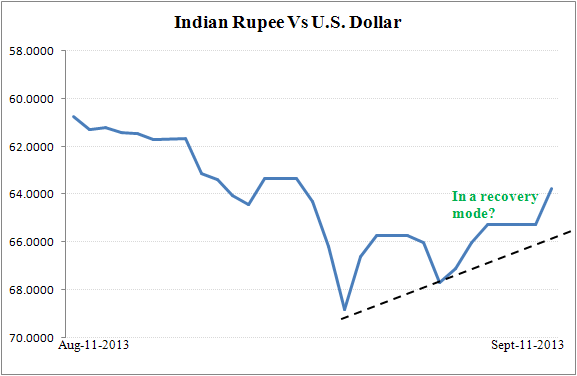
Suddenly the trend has reversed in rupee. From being one of the worst performing Asian currencies, it snapped back sharply to become the best performing one in last few days.
So 'what's up' with the rupee?
Reasons for fall in the rupee are known to our frequent readers. Although there is still no major change in the state of economy, rupee gained nearly 8% from its all-time low within just 10-12 days.
A Roller coaster Ride!
(Source: DGCI &S, RBI, PersonalFN Research)
There are mainly two factors that have been driving rupee up these days. Owing to weak macro- economic data in the U.S., tapering of monetary stimulus is being questioned again. This has arrested further outflows of dollars. The second factor has played a crucial role in the recovery of Indian currency. The newly appointed governor of RBI has been tirelessly assuring investors that fall in the value of rupee is overdone and India still has a potential to weather the economic downturn. He has already announced reforms to stabilise rupee.
Announcements that boosted the sentiment
- Overseas borrowing limit of banks is raised to 100% of their tier-1 capital from 50% allowed earlier.
- RBI to allow banks to swap Foreign Currency Non-Resident (FCNR) deposits through a special window with
These two measures are expected to bring in about USD 15 billion over next few months. Markets are pinning up their hopes on possibility of dollar inflows. Rupee has appreciated and equity and debt markets too have reacted positively to these developments. Foreign Institutional Investors (FIIs) have returned to Indian markets. Since these measures were announced, FIIs have pumped in about USD 1 billion in Indian markets. This has saved the rupee from going down further. India's trade deficit narrowed to USD 10.9 billion in August, hitting a 5-month low. Lower gold imports and 13% rise in exports helped bridge the gap in deficit. Narrowing deficits is a positive sign for rupee.
PersonalFN is of the view that optimism has boosted rupee. By announcing reforms RBI governor has bought time to improve conditions on ground. Although short term outlook is positive for rupee, over medium to long term, tangible improvements in the economy would decide the direction of Indian currency. PersonalFN believes investors shouldn't take any position in equity or debt based on market momentum. Instead, you would be better rebalancing your portfolio and staying away from speculation. Intelligent asset allocation, rather than speculation would take you closer to your financial goals.
|
Impact 
It's a widely accepted belief that insurance is a 'push' product in India. Unless approached repeatedly, people don't buy insurance on their own. To lure potential customers, insurance companies try out different advertising and marketing tactics. Insurers advertise benefits of plans they offer. What's more, they also offer some special discounts to attract new customers. With growing usage of internet, insurance companies have started using internet platform to market their products aggressively. However, after having reviewed the trend of advertisements recently, Insurance Regulatory and Development Authority of India (IRDA) tightened up advertisement norms for life insurers.
Stricter norms are aimed at improving transparency of insurance advertisements. The regulator has asked insurance companies to stay away from offering any rebate, discounts points, rewards/awards unless approved by the regulator as product features. Also, IRDA has urged insurers to improve their compliance for internet advertisements. Wherever benefits of two products are being shown in combination in a single ad; the insurance company must also disclose details of individual products separately. These advertisements must carry an "advertisement disclaimer" on top in bold with a font size of not less than 7.
PersonalFN believes, tightening of advertisement norms is a welcome move but that wouldn't be sufficient in protecting buyers from catchy advertisements. More often in India, insurance plans are sold as investment plans rather than indemnity contracts against loss of life of the buyer. The greed of buyers to earn something on the amount paid as premium gives insurers opportunities to come up with fancy advertisements making lofty claims. Going for pure risk cover i.e. term insurance, may substantially lessen the risk of being fooled by tall claims of insurance companies.
| Signup Today for...Money Simplified - Your Guide to Money & Mutual Funds
Learn right from basics of investing to planning your life's goals!
...Also Get FREE Guide on
"16 Rules of Investment Success" - by Sir John Templeton
Click Here to Sign Up! | |
Impact
It is a known fact that markets are driven by sentiments in the short term and tend to overreact to available information on positive as well as on the negative side. Optimism or pessimism often induces you to invest or holds you back from investing. In the long run markets run only on fundamentals, be any asset class, equity, debt or gold. This is why chasing markets is a bad idea. If you take investment decisions based on what Foreign Institutional Investors (FIIs) are doing or depending on the latest trend in the market; you should revisit your strategies as they may hurt your portfolio in the long run.
This is so true in Indian context today. Over last one month, equity as well as debt markets have seen extremes of volatility. Yield on 10 year G-sec benchmark bond moved in a range of nearly 14% while broader equity markets have swayed in the range of 9%. Flow of foreign money has also been erratic.
To read more about this news and the view of PersonalFN over it, please click here.
|
Impact
Lack of alternatives leads a bank to mis-sell. If you believe this to be true, mis-selling of insurance products by banks may substantially come down now. Insurance Regulatory and Development Authority (IRDA) had allowed banks to become insurance brokers last month. The matter was subject to the approval of RBI. In the past, the central bank was apprehensive about banks becoming insurance brokers as it was of the view that becoming insurance broker would expose them to additional risks. Possibility of conflict of interest (e.g. insurance company and the bank of a same promoter group) was another factor that RBI considered a negative for banks assuming a role of insurance distributors.
On this background RBI had expressed its reservations to liberal nature of guidelines proposed by IRDA earlier. After having received strong resistance from RBI, IRDA re-initiated a dialogue with various stakeholders such as banks, insurers and the government to fine-tune guidelines. The finance ministry somewhat played the role of a mediator and asked IRDA to review proposed guidelines. Seemingly, RBI is now convinced and satisfied with the modifications in the guidelines. It has given its nod to banks becoming insurance distributers. However, RBI held on to its stance to grant permission on selective basis. As a consequence, banks would now only sell standard insurance products issued by various insurance companies through their branches. Insurance products sold through banks would be standardised for features and commission structure.
To read more about this news and the view of PersonalFN over it, please click here.
|
- Many of you must have traded in equity shares in the secondary market; thanks to ample of liquidity in the equity segment. But when it comes to debt securities, rarely investors trade in the secondary market. But this may change soon. Recently, Securities and Exchange Board of India announced that it will take some steps to improve liquidity and trading mechanism in debt markets. To start off, SEBI launched a Corporate Bond Information Data Base (CBID) which, it believes, would help publish debt market information, which was a difficult task till now.
PersonalFN believes that at a time when interest of investors in the debt segment is improving, initiatives taken by SEBI would have a positive impact. It will not only help investors to get timely information but also corporate raise money efficiently. This in turn would have many offering for retail investors.
|
Indemnity: Indemnity is a "compensation for damages or loss. Indemnity in the legal sense may also refer to an exemption from liability for damages. The concept of indemnity is based on a contractual agreement made between two parties, in which one party agrees to pay for potential losses or damages caused by the other party. A typical example is an insurance contract, whereby one party (the insurer) agrees to compensate the other (the insured) for any damages or losses, in return for premiums paid by the insured to the insurer."
(Source: Investopedia)
|
Quote : "Don't tell me where your priorities are. Show me where you spend your money and I'll tell you what they are." – James W. Frick
|
| |
| © Quantum Information Services Pvt. Ltd. All rights reserved.
Any act of copying, reproducing or distributing this newsletter whether wholly or in part, for any purpose without the permission of PersonalFN is strictly prohibited and shall be deemed to be copyright infringement.
Disclaimer: Quantum Information Services Pvt. Limited (PersonalFN) is not providing any investment advice through this service and, does not constitute or is not intended to constitute an offer to buy or sell, or a solicitation to an offer to buy or sell financial products, units or securities. All content and information is provided on an 'As Is' basis by PersonalFN. Information herein is believed to be reliable but PersonalFN does not warrant its completeness or accuracy and expressly disclaims all warranties and conditions of any kind, whether express or implied. PersonalFN and its subsidiaries / affiliates / sponsors or employees, personnel, directors will not be responsible for any direct / indirect loss or liability incurred by the user as a consequence of him or any other person on his behalf taking any investment decisions based on the contents and information provided herein. This is not a specific advisory service to meet the requirements of a specific client. Use of this information is at the user's own risk. The user must make his own investment decisions based on his specific investment objective and financial position and using such independent advisors as he believes necessary. All intellectual property rights emerging from this newsletter are and shall remain with PersonalFN. This is for your personal use and you shall not resell, copy, or redistribute this newsletter or any part of it, or use it for any commercial purpose. The performance data quoted represents past performance and does not guarantee future results. As a condition to accessing PersonalFN's content and website, you agree to our Terms and Conditions of Use, available here. |