  |
| May 31, 2013 |
|
|
|
|
|
| Weekly Facts |
|
Close |
Change |
%Change |
| BSE Sensex* |
19,760.30 |
55.7 |
0.28% |
| Re/US$ |
56.38 |
(0.8) |
-1.40% |
| Gold Rs/10g |
26,915.00 |
485.0 |
1.84% |
| Crude ($/barrel) |
102.01 |
0.1 |
0.11% |
| FD Rates (1-Yr) |
7.50% - 9.00% |
Weekly change as on May 30, 2013
*BSE Sensex as on May 31, 2013
|
|
Impact 
Making big bucks is a dream of everyone. Many of us may have contemplated participating in pyramid marketing or a Multi- Layer Marketing (MLM) scheme. Despite numerous instances of frauds, people often fall for exaggerated claims of companies or the middlemen who drag several into such schemes. And unfortunately since regulations aren't in place, company and their middlemen make hay. But now the Finance Ministry seems to have finally recognised the threat stemming from proliferation of such schemes and to crack the whip, is considering a ban.
The Department of Financial Services is pondering on the idea of banning pyramid marketing schemes by making amendments to "Prize, Chits and Money Circulation schemes (Banning) Act, 1978". But it is yet unclear whether MLM would also bear the brunt of the proposed banned. Technically, pyramid marketing schemes compensate participants for getting other people registered with company. Compensation is being paid for adding to the list of members registered with the company and there is no real exchange of goods or services at any level. On the other hand, MLM is a structure where the person(s) influencing others into the schemes is not only compensated for sale of some real products, but is also incentivised for sales undertaken by people recruited by him. The picture looks slightly obscure as far as banning MLM is concerned for the want of some changes in definitions which might be unwarranted while making amendments to the Act.
PersonalFN is of the view that, the primary intent of imposing a ban on ponzi and money circulation schemes was the method and purpose of compensation. While MLM also comes in the ambit of the aforesaid ban remains to be seen; on-going developments at least hint at tighter regulations for MLMs. PersonalFN believes that any scheme that promises you incredible success and portrays it to be the fortune changer, should be completely avoided. To earn attractive returns on investments one might consider time tested and well-regulated investment avenues. Personalised asset allocation and investment plan may help you achieve your long-term goals. While you may look like a turtle in the race of wealth creation, remember slow and steady wins the race.
|
Impact
The Gross Domestic Product (GDP) for the fourth quarter (Q4) of FY 2012-13 (FY 13) came in at 4.8% which is a tad higher than 4.7% reported in the second quarter of FY 13. However, it shows a declining trend on Year-on-Year basis. Tepid performance of agriculture, mining and manufacturing played a drag while services sector helped avoid the hard landing.
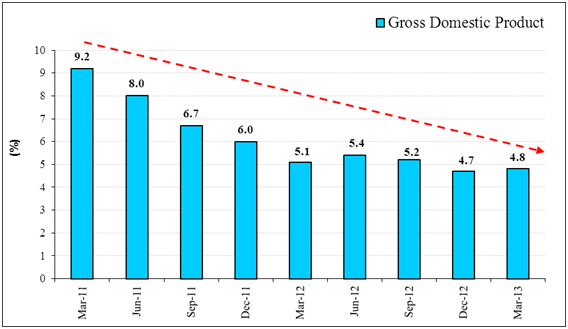
(Source: CSO, PersonalFN Research)
Growth in factory output as measured by movement of Index of Industrial Production (IIP) has depicted a weaker manufacturing growth and deceleration of growth in mining. This is further supported by a fall in the growth recorded by cement and steel sector in the 4th quarter Vis-à-vis the growth rate recorded during the period April-December 2012. Manufacturing registered a growth number of 2.6% in the Q4. Although this is substantially higher than 0.1% growth recorded in Q4 of FY 2011-12; it has remained almost at the same for last 2 quarters.
Although the latest estimates of crop production, as released by the Ministry of Agriculture, have been revised upwards, agriculture sector grew at 1.4% in Q4 as against the growth of 2.0% recorded during the same time period in FY 2011-12. The growth decelerated on Q-o-Q basisas well. Growth rate was the highest in Financing, Insurance, Real Estate and Business Services sector. Collectively the sub-sectors grew at 9.1% in Q4. But the growth rate slowed on Y-o-Y basis. Trade, Hotels, Transport and Communication sector recorded 6.2% growth in Q4 which is higher than 5.1% recorded during the same time period in FY 2011-12. However, the growth rate has been lower on Q-o-Q basis.
Share of personal consumption declined sharply on Quarter on Quarter (Q-o-Q) basis although it showed a slight uptick on Y-o-Y basis. To curb fiscal deficit, Government spent less in Q4 as compared to Q3 due to which share of Consumption Expenditure of government fell in Q4. On the other hand, despite showing some improvement during Q4, growth in exports remained lacklustre on Y-o-Y basis. Falling commodity prices in the international market helped reduce dependence on imports which reflects in Q4 GDP. On Q-o-Q basis share of imports has fallen although it hovers around the same levels reported in Q4 last year i.e. in FY 2011-12. To read more about this news and the view of PersonalFN over it, please click here.
---------------------- Introducing PersonalFN's Guide to Investing in Gold ---------------------
Many of us buy gold with an emotional touch. And why not, the glitter which it presents and the feeling of content it gives are truly worth it.
PersonalFN has Just Released a Guide to Investment in Gold, which reveals the smart way of investing in gold.
Download Your FREE Copy Here!
|
Impact 
Although high level of promoters' holding is considered to be a confidence booster; quality of corporate governance, indeed decides the fate of companies. If stake of the promoter group in the business is very high, the policies of the company might well be self-serving. In order to protect the interest of minority shareholders and increase the retail participation in the market; Securities and Exchange Board of India (SEBI) had amended SEBI (Issue of Capital and Disclosure Requirements) Regulations, 2009. Although the deadline is nearing (June 2013); more than 87 listed companies have not yet complied with minimum public shareholding norms.
Promoters of companies that are yet to comply with the norms might start off loading aggressively in coming days. The timing of these issuances might be concurrent to exuberant rallies in the market fuelled largely by global liquidity. Of late, markets have rallied in anticipation of possibility of further monetary easing by RBI. Cooling commodity prices which might reduce the import bill, have also aided. To read more about this news and the view of PersonalFN over it, please click here.
|
Impact
At present, to avoid higher out go, employers structure salaries in such a way that, when combined, "basic and DA" component forms an insignificant portion of the total pay-package. Any increment is often paid as "allowances". Any salary rise increases the tax liability (and often to a great extent) even after exhausting all permissible limits of tax exemptions and deductions. On the other hand, employers get all taxation benefits as "salary" being a deductible expense. Contributions by both, employee and the employer, in most cases remain almost unchanged even after hikes in salary.
To plug this loophole, Employees Provident Fund Organisation (EPFO) had issued a circular last year to "redefine" the term "basic salary" and include therein all payments other than those which are classified as "specified exclusions". Amidst vehement resistance demonstrated by various groups representing both sides; Labour Ministry had put the matter on hold and had set up a committee to check the merits of opposition. EPFO is soon expected to go ahead with the change as the committee has not found any merit in the argument against the proposed move. To read more about this news and the view of PersonalFN over it, please click here.
|
- In a bid to curb mis-selling of financial products and improve the quality of advice, Securities and Exchange Board of India (SEBI) introduced new regulations in January this year. The Securities and Exchange Board of India (Investment Advisers) Regulations, 2013 has enunciated requirements related to obtaining a certificate of registration, qualification, capital adequacy, period of validity of the certificate, and has also mentioned other general obligations and responsibilities on the part of investment advisors.
As per new rules those who want to engage themselves in advisory have to register themselves with SEBI by paying a fee of Rs 5,000. The capital market regulator has also made it compulsory for those who want to venture into the business of investment advisory to have a minimum net worth; wherein for body corporates it (the net worth) shall not be less than Rs 25 lakh, while for partnership firms and individual investment advisors, they shall have net tangible assets of not less than Rs 1 lakh.
PersonalFN is of the view that it's a welcome move and may help in increasing the accountability of advice. Registration and capital adequacy requirements imposed by new regulations would ensure that your advisor has financial strength to invest in advisory infrastructure which is imperative to client servicing. However, on the flip side, weaker advisors might have to shut their shops which would mean transfer of business from one entity to another. Investors may suffer if their advisor goes out of business for not being able to comply with the new regulations. Keeping a close eye to further developments may help investors.
- If you are planning to pledge units of Gold ETFs held by you to secure loans from banks and NBFCs, it would be no longer possible. By issuing new guideline, RBI has prohibited banks and NBFCs from disbursing loans against units of Gold Exchange Traded Funds (Gold ETFs) and mutual funds investing in gold ETFs. RBI has banned NBFCs from giving out loans against gold bullions or primary gold and gold coins. In a separate directive released for banks, RBI has set 50 grams as an upper limit for granting loans against gold coins.
The move of RBI is in line with the stance taken by government to curb gold imports. India runs a huge current account deficit on account of higher gold and crude oil imports. Government has been taking steps to discourage investors from buying gold in order to reduce gold imports and improve the current account deficit position.
PersonalFN is of the view that this move is unlikely to have any significant impact on inflows in gold ETFs and gold mutual funds. Individual investors look upon them as an avenue to diversify investment portfolio. Gold ETFs and gold mutual funds are a preferred route to take exposure to gold.
|
Ponzi Scheme: A fraudulent investing scam promising high rates of return with little risk to investors. The Ponzi scheme generates returns for older investors by acquiring new investors. This scam actually yields the promised returns to earlier investors, as long as there are more new investors. These schemes usually collapse on themselves when the new investments stop.
Source: Investopedia
|
Quote : "The four most dangerous words in investing are: 'this time it's different." - Sir John Templeton
|
|
|