  |
| May 02, 2014 |
|
|
|
|
|
| Weekly Facts |
|
Close |
Change |
%Change |
| BSE Sensex* |
22,403.89 |
-284.18 |
-1.25% |
| Re/US$ |
60.34 |
0.75 |
1.23% |
| Gold Rs/10g |
30,750.00 |
750 |
2.50% |
| Crude ($/barrel) |
109.41 |
0.00 |
0.00% |
| FD Rates (1-Yr) |
8.00% - 9.00% |
Weekly change as on April 30, 2014
*BSE Sensex as on May 02, 2014
|
|
Impact 
After a relatively dry spell in 2012, mutual funds houses are all out with New Fund Offers (NFOs) in 2014. And this time with the Indian equity markets near their all-time high, fund houses are making a proposition with equities. Over the past six months as many as 24 NFOs in the equity segment have hit the market. This year itself, until March, as many as 16 equity NFOs were launched, and even now as we are writing this article, it is raining NFOs. But this time, some fund houses, especially those launching funds focusing on emerging businesses, are offering close-ended funds with a lock-in period of two to five years.
Why equity NFOs back in fashion?
Well, it appears that mutual fund houses are trying to capitalise on the upbeat sentiments in the market ahead of the outcome of Lok Sabha elections. So it can be said that they are trying to make hay while the sun shines, in their race to garner more Assets Under Management (AUM).
Does it make sense to fall for this proposition?
PersonalFN is of the view that it is imprudent to fall for Rs 10 proposition unless the offer is unique and has capacity to add value to your portfolio. Our research reveals, sometimes fund houses launch new schemes whose portfolios nearly replicate the portfolio of the existing schemes. This thus indicate that sometimes NFOs are launched to create excitement in the market, which often benefits mutual fund distributors / agents / relationship managers (through luring commissions!) than investors.
One should not forget the NFO mania of 2006 and 2007, where mutual fund house raised stunning AUM but hardly gave any rewards to investors (as the U.S. sub-prime mortgage later engulfed the global economy in early 2008). This is because majority of the money came in when the indices were trading at higher levels. This time as well by launching equity mutual funds when valuations appear stretched (with trail P/E at about 19), denotes opportunistic nature of fund houses.
Taking a peep at the macroeconomic scenario, while the global economy is under a recovery mode, the edginess remains in the backdrop of tapering in stimulus by the U.S. and the debt-crisis in the Eurozone. In India, the challenges remain from fiscal deficit, inflation, lull in industrial and slower economic growth, amongst host of others. So during such times, it is imperative for you to invest you hard earned money wisely and not get lured by the excitement created by such fund launches or even the luring sales pitches given by your mutual fund distributor / agents / relationship managers. This is because today's market excitement need not guarantee you tomorrow's performance.
|
Impact
Over the past few months the Indian rupee has appreciated quite pleasingly against the U.S. dollar. It is now placed near Rs 60 a dollar and with elections under way, there are some who perceive that if the BJP led NDA comes to power with Mr Narendra Modi as it prime ministerial candidate it could even be much stronger.
So will the rupee indeed get stronger?
Well, the chances of the rupee getting much stronger from the current levels seem remote. The Reserve Bank of India (RBI) has signalled that it will not let the rupee appreciate beyond 60 a dollar. This is because the central bank will now shift to consumer prices as a basis of calculating the real effective exchange rate or REER. It is noteworthy that REER is the inflation adjusted value of the currency factoring in the inflation differentials among trading partners. It is an indication of the skew in exchange rates and until recently was calculated on wholesale prices.
You see, REER based on consumer prices is expected to reflect the fair value of the rupee (as compared to the erstwhile measure of using wholesale prices). Only if CPI inflation eases further, growth revives and if we have a stable Government at the centre, we could see some appreciation in the value of the Indian rupee. But the gains would be gradual. Also in all possibility, the central bank could intervene and buy U.S. dollars to maintain it near Rs 60 a dollar.
PersonalFN believes that RBI foresees the perils of a stronger rupee, by the way of inflation and hence has rightly taken such a measure. A stronger rupee could not only hurt exports, but also inflict dangers of high imports, especially of gold and oil, on trade deficit data.
|
Free Guide: The Ultimate Guide to Successful Equity Investing
The turbulent times encountered by equities over the past few years has sent shiver down the spine of many.
While many investors seem to have lost their faith in equities, those who have ignored fundamentals of investing, have been let down rather badly!
Now Prudently Make Money in Stock Markets!
Download the Ultimate Guide to Successful Equity Investing!
|
|
Impact
Unlikely the Indian equity markets, it's been rather a quiet journey for Indian debt markets. With inflation on Reserve Bank of India's (RBI's) vigil amongst host of other macroeconomic factors, interest rates in the country have remained rather elevated. So those who believed earlier in the thesis that interest rates may move down, have been disappointed. With yields of 10-Yr Government security also having moved up during such times, those who invested in long-term debt funds were also disappointed. But on the other hand, those who invested in short term debt funds witnessed better returns or outperformance rather comfortably. You see, short term debt funds have outperformed across time frames (see chart below)
Short Term income Funds vs. Long Term Income Funds
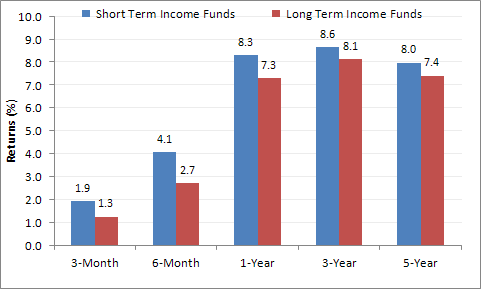
Data as on April 28, 2014
Note 1: Returns upto one year are expressed in absolute terms, while for those over a year are compounded annualised
Note 2: Category average of short term income funds and long term income funds is considered to measure performance
(Source: ACE MF, PersonalFN Research)
To read why short term debt funds have outperformed and what you can expect going forward, please click here. |
Impact 
Polling is underway for the 16th Lok Sabha elections and the mood is gripping. It is possibly the most exhilarating elections ever in the history of India, poised on ideologies and manifestos. After ten years of two UPA regimes, there suddenly seems to be an anti-incumbency wave in the country. The BJP led NDA has been aggressive in its electoral campaigning with Mr Narendra Modi as its prime ministerial candidate, while the Congress led UPA which is surrounded by allegations of scams, has been defensive. It is showcasing what it has achieved in the last 2 terms. Interestingly the voter turnout has been high this time as compared to 2009; and the urban voters are expecting a change at the centre. The Indian equity markets are also hopeful of BJP led NDA coming to power. But eventually it remains to be seen whether the nation grooves to RaGa tune or sways by NaMo wave.
The outcome of general elections is scheduled on May 16, 2014 and the capital market regulator - Securities and Exchange Board of India (SEBI), stock exchanges and market intermediaries are working to ring-fence the system and infrastructure from any sudden volatility on the results day, or around that date, amid times when the stock markets are scaling highs on the hopes of strong and stable Government at the centre.
To read more about this news and the view of PersonalFN over it, please click here.
|
- The money lying in an employees' provident fund account is the hard earned money of salaried individuals which can help in meeting his / her retirement needs. Provident Fund (PF) corpus that you build over your entire working life is a significant contributor to your retirement wealth.
You see, big corporate and Public Sector Undertakings (PSUs) have their own PFs and are classified as 'exempted' funds. They follow different investment pattern as against the stringent norms prescribed for 'unexempted' PFs that come under the Employees Provident Fund Organisation (EPFO). Exempted PFs follows investment norms notified by the finance ministry in 2008 which allow them to invest 55% in Government bonds, 40% in corporate bonds and bank fixed deposits, 5% in money market instrument and 15% in equities on which derivatives are available in BSE or NSE and/or equity linked schemes of mutual funds regulated by the SEBI.
But suspecting defaults by some state PSUs on their bonds, EPFO may debar such exempted PFs from investing in PSU bonds that are not guaranteed by the respective states and are likely to tighten norms. The EPFO suspects that the 'exempted' funds may have invested about Rs 10,000-12,000 crore in state PSU bonds that are not guaranteed by the respective state Governments.
PersonalFN is of the view that, here's something which is impairing the safety of this investment avenue, and the EPFO is right in stepping in and tighten investment norms for 'exempted' PFs because after all it is investors hard earned money which can help make some provision for your golden years.
|
Provident Fund: A compulsory, government-managed retirement savings scheme used in India, Hong Kong, Singapore, Malaysia, Mexico and other countries that is similar to the United States' Social Security program. It is run by a government for the benefit of its citizens. A provident fund is a form of social safety net into which workers must contribute a portion of their salaries and employers must contribute on behalf of their workers. The money in the fund is then paid out to retirees, or in some cases to the disabled who cannot work.
(Source: Investopedia)
|
Quote : "Investing is the intersection of economics and psychology." - Seth Klarman
|
|
|
|
© Quantum Information Services Pvt. Ltd. All rights reserved. Any act of copying, reproducing or distributing this newsletter whether wholly or in part, for any purpose without the permission of PersonalFN is strictly prohibited and shall be deemed to be copyright infringement.
Disclaimer: Quantum Information Services Pvt. Limited (PersonalFN) is not providing any investment advice through this service and, does not constitute or is not intended to constitute an offer to buy or sell, or a solicitation to an offer to buy or sell financial products, units or securities. All content and information is provided on an 'As Is' basis by PersonalFN. Information herein is believed to be reliable but PersonalFN does not warrant its completeness or accuracy and expressly disclaims all warranties and conditions of any kind, whether express or implied. PersonalFN and its subsidiaries / affiliates / sponsors or employees, personnel, directors will not be responsible for any direct / indirect loss or liability incurred by the user as a consequence of him or any other person on his behalf taking any investment decisions based on the contents and information provided herein. This is not a specific advisory service to meet the requirements of a specific client. Use of this information is at the user's own risk. The user must make his own investment decisions based on his specific investment objective and financial position and using such independent advisors as he believes necessary. All intellectual property rights emerging from this newsletter are and shall remain with PersonalFN. This is for your personal use and you shall not resell, copy, or redistribute this newsletter or any part of it, or use it for any commercial purpose. The performance data quoted represents past performance and does not guarantee future results. As a condition to accessing PersonalFN's content and website, you agree to our Terms and Conditions of Use, available here.
|