| S&P BSE Sensex* |
Re/US $ |
Gold Rs/10g |
Crude ($/barrel) |
FD Rates (1-Yr) |
19,429.23 | (330.8) 
-1.67% |
56.85 | (0.5)
-0.83% |
27,570.00 | 655.0 
2.43% |
102.61 | 0.6
0.59% |
7.00% - 8.75% /td> |
Weekly change as on June 06, 2013
*BSE Sensex as on June 07, 2013
Impact 
It is always said that 'buyers beware'. Till recently it wouldn't have served any purpose although you might have been cautious while buying a house. There was virtually no dedicated regulator to keep belligerent real estate developers under check. But now soon this picture might change. The Union Cabinet has recently cleared the much awaited Real Estate (Regulation and Development) Bill which furnishes establishment of a dedicated regulator for realtors. The bill intends to protect buyers' interest and bring transparency to the sector. Some of the key points are;
- Developers can launch projects only after securing all clearances
- It is mandatory on builders to have a clear mention of carpet area
- Penalties of upto 10% of the project cost if builders found guilty of putting out misleading advertisements and even a jail for repeated misdeeds
- Now developers can take only upto 10% amount in advance without a written agreement.
- It is now mandatory on developers to maintain 70% of the amount collected from investors in a separate bank account for every project.
- Buyers can get full refund with interest in case of delay in projects
PersonalFN is of the view that enactment of Real Estate (Regulation and Development) Bill would be the first step taken in the direction to regulate builders lobby. However, there have been some shortcomings which severely limit the effectiveness of the bill. The first and foremost has been that the bill would be applicable only to projects which are in excess of 4,000 square meters in size. Moreover, it is stated that there will be one regulator in every state which may cause delay in getting clearances. Also, the bill keeps commercial real estate projects out of its purview. PersonalFN believes that although the bill tries to curb malpractices and bring transparency the enactment and meticulous execution of the bill holds the key.
Has Your Mutual Fund Disappointed You?
Impact 
Markets rise and fall on hopes; positive or negative developments on ground happen with a lag. If this holds true even this time; markets might just have run ahead of their fundamentals. In the year 2012, Indian equities rallied on rejuvenated effort of the Government to push through some critical reforms and pro-growth stance taken by RBI. However, despite of all these efforts, demand in the economy seems to have failed to revive which reflects in dipping domestic consumption and wanning corporate profits. Foreign Institutional investors (FIIs) have pumped in money in India as flow of money in the global system remained robust. Aggressive FII buying pushed market valuations upwards hoping that growth in corporate earnings would follow. However, optimism has been dashed once more. As per the report published by mint recently, about 296 companies on BSE-500 index have collectively reported 10.1% fall in profits on Year-on-Year basis in the 4th quarter of Financial Year (FY) 2012-13. This has been the first decline in last 4 quarters. Moreover, sales growth of 2.3% during the quarter ended on March 31, 2013, has been the slowest in last 14 quarters. This leaves us in a situation where markets have rallied on hopes and corporate profits have failed to catch-up.
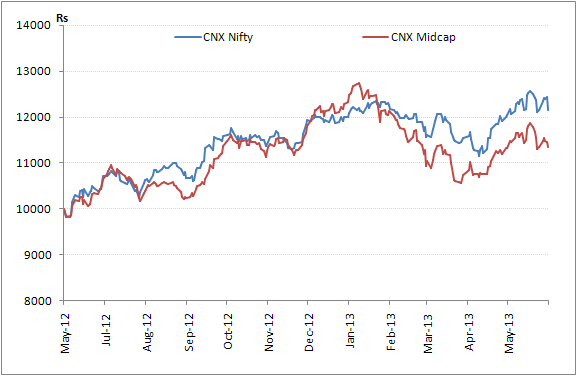
| Performance: CNX Nifty Vs. CNX Midcap |
Valuations: CNX Nifty Vs. CNX Midcap |
 |
 |
Data as on May 31, 2013
(Source: NSE, ACE MF, PersonalFN Research)
Chart on your left shows how the investment of Rs 10,000 in CNX Nifty and CNX Midcap made on May 31, 2012 would have fared over last one year; while the one on your right depicts the movement of relative valuations. Investment of Rs 10,000 in CNX Nifty and CNX Midcap would return Rs 12,156 and Rs 11,339 respectively over the period of 1 year i.e. between May 31, 2012 and May 31, 2013. Midcaps have witnessed more volatility in comparison to their largecaps. Notably, valuations, as measured by Price to Earnings (PE) multiple, are dearer in midcaps now than they were a year before. On the other hand, despite the up-move witnessed over last 1 year, valuations in CNX Nifty have remained relatively consistent as compared to those in the midcaps. As a mutual fund investor, you might be keen to know how mutual funds have performed on the same time period. Let's find out... To read more about this news and the view of PersonalFN over it, please click here.
---------------------- Introducing PersonalFN's Guide to Investing in Gold ---------------------
Many of us buy gold with an emotional touch. And why not, the glitter which it presents and the feeling of content it gives are truly worth it.
PersonalFN has Just Released a Guide to Investment in Gold, which reveals the smart way of investing in gold.
Download Your FREE Copy Here!
Would all these tricks help in reducing gold imports?
Impact
The government is trying to pull out all the stops to lessen the widening current account deficit. The recent hikes in the import duty on gold seem to have shown no effects on gold imports. Slump in gold prices has watered down the impact of duty hikes. However, the government has not lost hopes yet. It has upped the duty once again. From previous 6%, the duty has now been raised to 8%. Besides, several others steps are also being taken to discourage people from buying gold. After having imposed gold import restrictions on banks earlier, RBI recently extended the restrictions to all nominated agencies except form jewellery exporters. Furthermore, as hinted by the Department of Economic Affairs, the banks might soon be banned from selling gold coins. In another move, RBI banned NBFCs from giving out loans against gold bullions or primary gold and gold coins. In a separate directive released for banks, RBI has set 50 grams as an upper limit for granting loans against gold coins.
Despite all efforts, the government has failed to curb gold imports so far. As estimated by the World Gold Council, India is expected to import about 300-400 tonnes of gold in the first quarter of Financial Year 2013-14, almost double of imports recorded for the same time period last fiscal. PersonalFN is of the view that, investors look upon gold as a hedge against inflation. High retail inflation eats into returns generated by fixed income bearing instruments. Sloppy performance of equities over last 5 years has also been one of the reasons for the unprecedented surge in gold buying. The government has tried addressing this by launching inflation indexed bonds linked to Wholesale Price Index (WPI). However, PersonalFN believes that linking inflation indexed bonds to Consumer Price Index (CPI) would make them more attractive to investors. Food price inflation has been the real worry which gets true reflection in CPI and not in WPI. For now it remains to be seen whether steps taken by the government to curb gold imports work.
RBI firm on guidelines. Wait for new banks gets longer!
Impact
India is an under-banked country. Only about 35% of adult Indians have a bank account as against the global average of 50%. The banking penetration in India is largely restricted to urban areas. In order to expand the reach of banking services; about 3 years back the Government had decided to allow issuance of new banking licenses in the private sector. However, keeping in mind role of banking sector in the economy; issuing a banking license requires thorough and meticulous assessment of all applications. Reserve Bank issued draft guidelines in August 2011. In consultation with the Government and based on suggestions received; RBI made some important amendments to The Banking Regulation Act, 1949, and also finalised the guidelines in February 2013. Final guidelines reflect the expectations of the regulator from aspirant banking corporations in respect to structure, capital requirements, reach and role to be played in development.
Earlier, RBI had said that all banking licenses would be reviewed on 'fit-and-proper' criterion. Besides, assessment of promoters and the management of the prospective bank it was also felt necessary to ensure that businesses are not 'misaligned' with banking model. Many aspirants sought clarification on some of the terms used in guidelines and requested inclusive definitions. To read more about this news and the view of PersonalFN over it, please click here.
And Other News...
- General Election of 2014 might be a year away but the game of wooing different pockets of voters seems to have begun. On one hand the government is showing concerns about high fiscal deficit and on the other it is planning for generous schemes. Recently, the government expressed its intent of considering minimum pension of Rs 1,000 every month for all workers covered under Employees' Provident Fund Organisation (EPFO). As quoted by Ministry of Labour and Employment, at present nearly half the pensioners get a pension of less than Rs 1,000 a month. The move is said to be targeted at helping members of EPF to counter inflation.
However, PersonalFN is of the view that retail inflation is high and stubborn; the proposed monetary incentives may not be adequate to fight inflation. Instead, the government should try to improve supply side measures, avoid red tape and should work on taking out all the bottlenecks. Announcing paltry monetary incentives hardly serve any purpose.
- Owing to relentless redemptions from equity schemes and intense competition, mutual fund houses are having a tough time. Thus, industry has been in a consolidating phase where bigger players are acquiring businesses of smaller players who are finding it difficult to sustain operations. Diawa is the latest in the list of mutual fund houses that have put their assets on the block. SBI Mutual Fund has acquired assets of Diawa for an unknown value. However, it is believed that SBI Mutual Fund is acquiring just assets and not the full-fledged asset management company.
PersonalFN is of the view that the acquisition may help SBI achieve greater penetration while it would provide investors an opportunity to benefit from the fund management skills of SBI Mutual Fund which has a decent performance record.
Financial Terms. Simplified.
Floor Area Ratio: The total square feet of a building divided by the total square feet of the lot the building is located on. FAR is used by local governments in zoning codes. Higher FARs tend to indicate more urban (dense) construction.
Source: Investopedia
(Source: Investopedia)
Quote : "The question isn't at what age I want to retire, it's at what income" - George Foreman