 |
| February 20, 2015 |
| |
| Weekly Facts | | | Close | Change | %Change | | S&P BSE Sensex* | 29,231.41 | 136.48 | 0.47% | | Re/US $ | 62.34 | -0.03 | -0.05% | | Gold Rs/10g | 27,100.00 | -300.00 | -1.09% | | Crude ($/barrel) | 58.53 | 4.30 | 7.93% | | F.D. Rates (1-Yr) | 7.25% - 8.75% | Weekly change as on on February 19, 2015
*BSE Sensex as on February 20, 2015 |
Impact 
It appears that mutual funds are anticipating a strong economic recovery which is why they are betting on cyclical sectors. Cyclicals had a rough ride so far. In the recent past we covered a story highlighting bullishness of mutual funds on banking sector. Now we bring to you even more interesting findings. Capital goods sector is the second most preferred sector of top 5 mutual funds after banking. Despite banking being the topmost pick of mutual funds; relative weight of the sector vis-à-vis its sectorial weight in CNX 100, is lower. But on the other hand, relative weight of capital goods sector in the equity portfolios of top 5 mutual funds is way above that in CNX 100.
As reported by the Economic Times dated February 19, 2015, top 5 mutual fund houses (by AUM) have assigned atleast double of weightage to capital goods sector, as a percentage of AUM, as compared to that in CNX 100. While banking has almost 32% weightage in CNX 100 as per the same report, weight of capital goods sector in the CNX 100 index has been a little above 6%. This suggests that although banking gets maximum of investments done by top 5 mutual funds, mutual fund managers are not as bullish on it as they are on capital goods sector.
Are fund managers on a right track?
Since fund managers are qualified and experienced professionals managing your money; it might be safe to assume that, they don't take decisions without doing their homework. Yet, such a vast difference in the allocation to a sector as compared to that in its benchmark might look surprising.
Why capital goods sector?
Fund managers are betting cautiously on banking due to asset quality problems faced by the sector. They are avoiding large investments in FMCG sector as well due to very high valuations. Against this, valuations in capital goods sector are attractive, as believed by the fund managers and prospects for the sector appear bright to them.
Current state of capital goods sector
So far output in capital goods segment, as denoted by the capital goods index forming a part of Index of Industrial Production (IIP), has remained weaker. Any rise in output has not sustained because of low economic activities and weak demand.
Weaker growth...

Data as on December 2014
(Source: MOSPI, PersonalFN Research)
What has affected the capital goods sector negatively?
- Stalled projects
- Lack of clearances to mega projects
- Weaker economic growth
- Lower incremental demand
- Higher interest rates
- Critical financial condition of many companies operating in the sector
Aforesaid factors suggest that, problems faced by the capital goods sector are structural and more chronic in nature. PersonalFN is of the view that it might take more than just a few announcements to improve the state of capital goods sector.
What Government has done so far...
The Government has launched 'Make in India' economic programme which focuses on boosting manufacturing growth in the country. This is expected to be a big positive for companies engaged in capital goods sector. India aims to raise share of manufacturing in Gross Domestic Product (GDP) from about 16% at present, to 25% of GDP by 2022. For achieving this, new processes have been envisaged; wherein there have been plans of developing and promoting manufacturing cities. A separate cell has been created to assist business houses and address their queries. The programme is expected to be tracked and monitored closely.
It is widely anticipated that, the Government may unveil favourable policies to shore up performance manufacturing industries in the foreseeable future. Capital goods sector would be one of the biggest beneficiaries, if that happens. Some of these announcements are expected to happen as early as in the upcoming budget. In September 2014, the Government sanctioned Rs 930 crore to incentivising capital goods sector to raise its competitiveness on the global stage. Factors such as stable rupee and fall in commodity prices are also expected to improve profitability of companies engaged in capital goods sector.
Sensing this as an opportunity to garner more AUM, mutual funds have launched dedicated 'make in India' focused funds. Thus, PersonalFN believes, rather than betting on particular sectors, it would be wise if mutual funds try to identify good companies across spectrum of sectors while building a diversified portfolio. Although 25 sectors form a wide enough basket for mutual funds to pick stocks from (25 sectors have been identified for 'Make in India' initiative), funds may still lack access to some major sectors of Indian economy, if they follow the theme in stricter manner.
PersonalFN is of the view that, rather than betting on thematic funds, you may consider investing in diversified funds following an opportunities mandate, which can give you exposure to the theme such as "make in India, along with the others, thereby ensuring adequate diversification.
PersonalFN believes investors should consider risk involved in any investment proposition. You shouldn't forget that "theme infrastructure" looked extremely convincing in 2005, turned even more appealing in 2006 and appeared compelling in 2007 with rising markets. However, you can't imagine how devastating it turned out to be in 2008-09 when markets tanked. The theme still has not made a comeback in a meaningful way. Remember, good investing is not exciting, but essentially boring. It remains to be seen how far capital goods sector goes in rewarding investors.
|
Impact
Credit cards are popular with users because they give them a chance to spend instantly and repay later. You are not charged any interest if you pay off your dues in time. But if someone tells you to pay in advance and consume later, would you accept such a deal? Most of you may not. However, it seems that mutual funds in India have come to a stage where they are accepting all deals that help them grow their asset base.
As reported by the Business Standard dated February 16, 2015 commission to be paid this year would be much higher than the combined profit of the top 10 AMCs in terms of size. This year, net inflows in equity oriented funds in first 10 months have been close to Rs 1.2 lakh crore. It is estimated that, mutual funds mopped up nearly Rs 13,000 crore by close to 70 close ended New Fund Offers (NFOs). Mutual funds pay 5%-8% upfront commissions on close ended NFOs. While fund houses paid Rs 2,600 towards commissions in total last fiscal, this fiscal, commissions to be paid towards fresh inflows are estimated to be Rs 2,000 crore, over and above total commissions paid in Financial Year (FY) 2013-14. Mutual funds may draw benefits only in coming 3-4 years.
Now mutual funds are testing new commission structures to limit their upfront payments. PersonalFN believes rather than reworking commission structure, it is high time mutual funds should switch to non-commission oriented models. PersonalFN has always believed that, commission oriented model won't work in the long run as commission would remain the biggest incentive to the distributor, giving rise to a problem of mis-selling.
On the contrary, a fee based model, as exercised by some financial planners these days is more suitable. Charging fees for advice makes advisors more accountable. Furthermore, PersonalFN believes there is no alternative to educating investors and encouraging them to invest in mutual funds wisely. If this happens mutual funds would no longer be a push-product. PersonalFN provides fee based, unbiased mutual fund research services.
Do you think fee-based model is a better substitute to the existing commission driven model? Share your views |
Impact 
While capital markets are eagerly waiting for the budget hoping it to spur reforms; broader macroeconomic indicators suggest a more quiet recovery. Recently disclosed GDP data was confusing rather than appeasing. GDP calculated using new method shot up to 7.5% in the 3rd quarter of Financial Year (FY) 2014-15. Since such a sharp spike wasn't backed by other indicators; it gave rise to many questions. Other indicators such as inflation indices, factory output data, import-export numbers, credit growth indicators and corporate results point at weaknesses of the economy. Let's have a look at each of them one by one.
Sluggish growth in manufacturing: Index of Industrial Production (IIP) grew at 1.7% in December 2014. Barring exception of May; IIP growth has stayed below 5% throughout the year 2014. Ordinary growth in manufacturing and poor performance of mining sectors dragged the performance. Manufacturing index which is the main constituent of IIP Index grew at just 2.1% in December 2014; whereas mining activities shrank by -3.2%. Unless IIP growth revives and sustains at higher level; recovery in GDP growth would remain less convincing.
To read more about this news and PersonalFN's views on it, please click here.
|
Impact
Be it politics or investing, Indians are going beyond their conventional choices these days. An overwhelming referendum in favour of Aam Aadmi Party (AAP) in Delhi Legislative Assembly elections, shows political parties can no longer take voters for granted. Similarly, in investing, Indians are believed to be more inclined towards investing in physical assets rather than the financial assets. Gold is one of their favourites. However, you would be surprised to know that investors are selling gold and moving to financial assets of late.
Indian investors turning away from gold
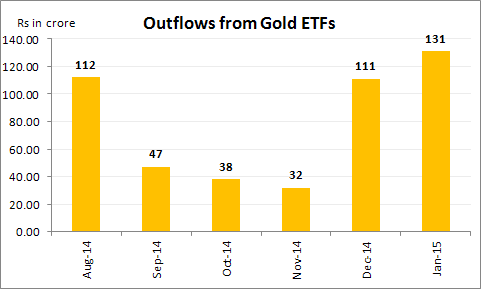
Data taken for the end of respective months, extracted as on February 17, 2015
(Source: AMFI, PersonalFN Research)
Gold prices in India are down nearly 10% over the last 1 year. While in the international market they have corrected around 7%. The Indian equity market (i.e. the S&P BSE Sensex) on the other hand, has delivered a return of little over 42% over last 1 year. The fall in gold and rise of in equities is not accidental; but reflect that amid the period of exuberance people are going risk-on, chasing an asset that is moving up in value and avoiding the one which is losing sheen. Equity mutual funds collectively saw an addition of 4.6 lakh new folios in January 2015, highest in any month from 2008. On the other hand, gold Exchange Traded Funds (ETFs) experienced outflows worth Rs 131 crore collectively.
To know more about this story and to read our views, please click here
|
- With a view of countering the problem of massive rise in smuggling activities; RBI recently decided to do away with the restrictions on banks for importing gold. However, RBI has reiterated that 20:80 scheme which requires importer to export minimum of 20% of the gold imported would stay. Nominated banks can now import gold on consignment basis but only by making upfront payment. They may also grant gold metal loans. However, they have been restricted from selling gold coins. Star and Premier Trading Houses (STH/PTH) are also free to import gold on DP basis.
PersonalFN believes this move may help jewellery exporters secure gold smoothly. Also, continuation on the restriction on gold coins by banks may help curb domestic demand. PersonalFN believes, the RBI has tried to do a balancing act by trying to smoothen imports at the same time making sure it won't affect Rupee stability in a significant manner.
|
Capital Expenditure (CAPEX): Funds used by a company to acquire or upgrade physical assets such as property, industrial buildings or equipment. This type of outlay is made by companies to maintain or increase the scope of their operations. These expenditures can include everything from repairing a roof to building a brand new factory.
(Source: Investopedia)
|
Quote : "Stocks aren't lottery tickets. There's a company attached to every share." - Peter Lynch
|
| |
| © Quantum Information Services Pvt. Ltd. All rights reserved.
Any act of copying, reproducing or distributing this newsletter whether wholly or in part, for any purpose without the permission of PersonalFN is strictly prohibited and shall be deemed to be copyright infringement.
Disclaimer: Quantum Information Services Pvt. Limited (PersonalFN) is not providing any investment advice through this service and, does not constitute or is not intended to constitute an offer to buy or sell, or a solicitation to an offer to buy or sell financial products, units or securities. All content and information is provided on an 'As Is' basis by PersonalFN. Information herein is believed to be reliable but PersonalFN does not warrant its completeness or accuracy and expressly disclaims all warranties and conditions of any kind, whether express or implied. PersonalFN and its subsidiaries / affiliates / sponsors or employees, personnel, directors will not be responsible for any direct / indirect loss or liability incurred by the user as a consequence of him or any other person on his behalf taking any investment decisions based on the contents and information provided herein. This is not a specific advisory service to meet the requirements of a specific client. Use of this information is at the user's own risk. The user must make his own investment decisions based on his specific investment objective and financial position and using such independent advisors as he believes necessary. All intellectual property rights emerging from this newsletter are and shall remain with PersonalFN. This is for your personal use and you shall not resell, copy, or redistribute this newsletter or any part of it, or use it for any commercial purpose. The performance data quoted represents past performance and does not guarantee future results. As a condition to accessing PersonalFN's content and website, you agree to our Terms and Conditions of Use, available here.
Quantum Information Services Pvt. Ltd. 101, Raheja Chambers, 213, Nariman Point, Mumbai - 400021. Tel: +91 22 6136 1200
Website : www.personalfn.com CIN: U65990MH1989PTC054667 |